Elected a full voting member of the Agriculture Committee
Renew Europe MEPs voted 41 of 67 to appoint Ciaran as a full member of the European Parliament’s Committee on Agriculture and Rural Development (AGRI), which shapes the CAP and other key farm legislation.
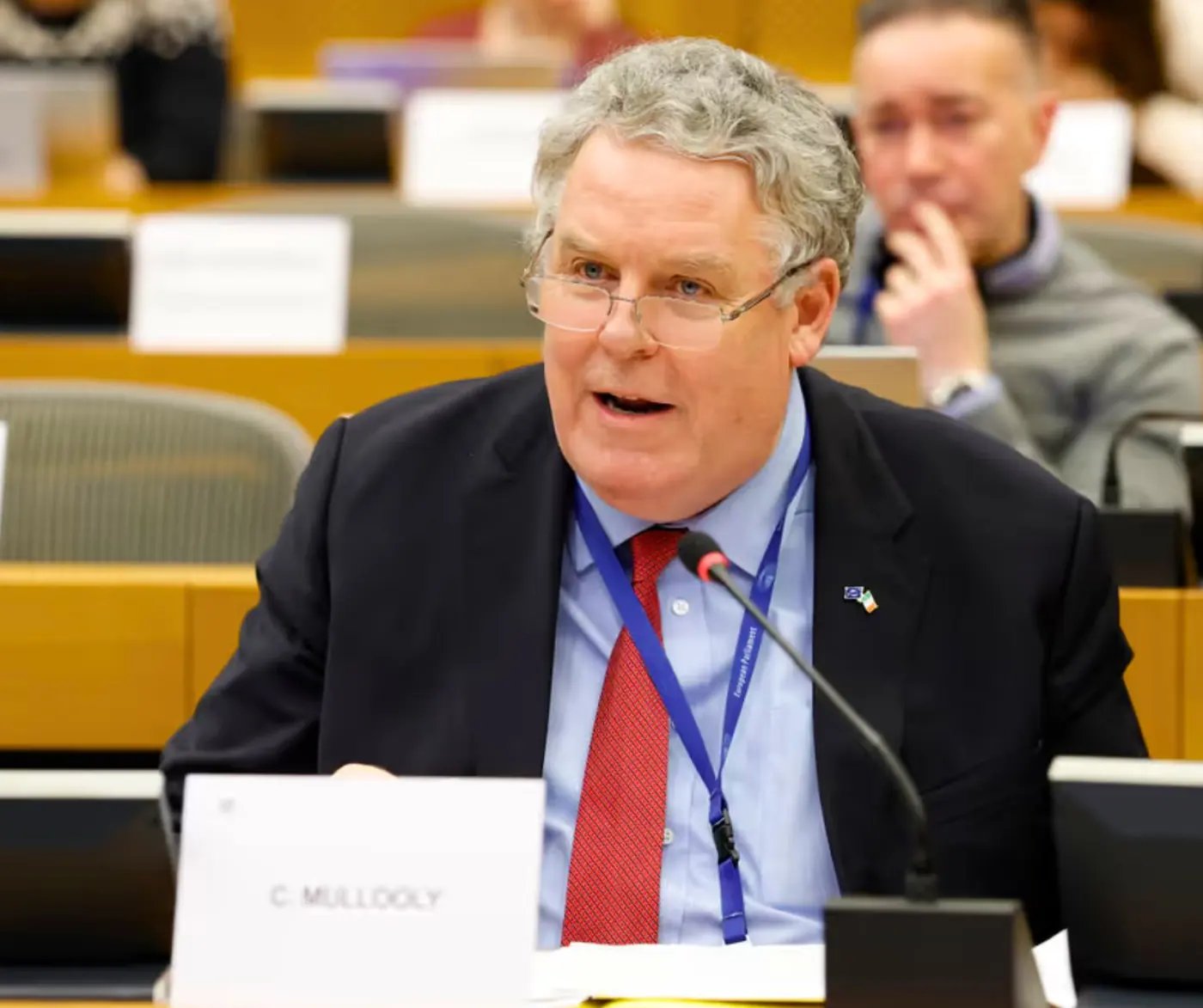 Office of Ciaran Mullooly MEPSpeaking in an Agriculture Committee session, European Parliament
Ciaran was elected a full voting member of the European Parliament’s Committee on Agriculture and Rural Development, known in Brussels as , after a vote of Renew Europe MEPs in which he secured 41 of 67 votes. He had previously been a substitute member, able to attend, speak and stand in for absent colleagues, but without a vote of his own on the committee’s reports and amendments.
The distinction matters more than it sounds. Committees are where European legislation is written in detail. A Commission proposal arrives, a is appointed to draft the Parliament’s response, every political group appoints a to negotiate on its behalf, and members table amendments line by line. Those amendments are voted in committee, and the resulting report becomes the Parliament’s negotiating position for the talks with the of member state ministers and the Commission. A full member votes at every one of those stages.
For a constituency like Midlands–North-West, where agriculture underpins much of the rural economy across Cavan, Monaghan, Roscommon, Leitrim, Mayo, Galway, Longford, Westmeath, Offaly and Laois, having an Irish voice with a vote on that committee is a concrete thing. The files coming through it in this term include the next Common Agricultural Policy, the rules on agri-food promotion, the unfair trading practices framework, milk supply contracts and a series of trade-related questions about imported beef and sheepmeat.
What the Agriculture Committee does
AGRI is one of the Parliament’s larger and busier committees. Its remit covers the Common Agricultural Policy, rural development, animal and plant health, forestry, agri-food quality schemes and the agricultural aspects of trade agreements. It scrutinises the Agriculture Commissioner, holds structured dialogues with the Commission, and produces both legislative reports and own-initiative reports setting out the Parliament’s view on questions where it has no formal power.
The Common Agricultural Policy it shapes is the single largest item in the European budget and rests on two pillars. Pillar one pays direct income support to farmers, calculated largely per hectare and conditional on environmental and animal welfare standards. Pillar two funds rural development: schemes for young farmers, environmental and climate measures, on-farm investment, and programmes such as that channel money to locally chosen projects through community-led local action groups. Both pillars are being renegotiated for the period from 2028.
Ciaran also leads the agriculture portfolio for the European Democratic Party within Renew Europe and has been appointed shadow rapporteur on the agri-food promotion legislation. Taken together with membership of the Regional Development Committee and the vice-chairmanship of the Special Committee on the Housing Crisis, the appointment consolidates a set of roles all of which bear on rural Ireland. The vote itself was among group colleagues rather than the full Parliament, reflecting how committee seats are allocated: each political group receives a share of places proportional to its size, and decides internally which of its members take them.
Read moreGalway Bay FM Shannonside
Sources: Commission CAP proposal; AGRI Committee; Roscommon People, 30 June 2026; Midwest Radio, 5 May 2026; CSO Farm Structure Survey 2023.
The CAP is the EU’s farm policy and one of its largest budget lines. It pays direct supports to farmers (Pillar 1) and funds rural development, including agri-environment schemes, young farmer supports and LEADER (Pillar 2).
The next CAP will run from 2028 to 2034. The Commission has proposed merging it into single national and regional plans, which would end its ring-fenced budget. Parliament’s Agriculture Committee, where Ciaran is a full voting member, is now amending the proposals before negotiations with national governments.
Related.
Ciaran hosts a European conference on island communities and the “Right to Stay” in Longford
“Sustainable Development, Depopulation and Connectivity for EU Islands: Challenges, Opportunities and the Right to Stay”, on Friday 27 November at Longford Rugby Club, 10am to 2:30pm. Free, with limited places.
 Mullooly Matters
: From the Cavan Farm to Brussels, Sophie Bell on Farming’s Future
The new episode of Ciaran’s weekly podcast features Sophie Bell, a young farmer from Virginia, Co. Cavan, on farming’s future.
 Diliff, CC BY-SA 3.0, Wikimedia Commons
‘UK must ban Brazilian beef next’: Ciaran welcomes the EU–UK food and agriculture agreement
Ciaran welcomed the conclusion of negotiations on a new EU–UK agreement on food, agriculture, animals and plants, due to apply from 1 March 2028, and called for strong food-safety safeguards and no gaps for third-country imports.