Athlone protest: the Mercosur fight moves to the European Parliament
Addressing a protest in Athlone organised by Independent Ireland and supported by the IFA, Ciaran said MEPs from other member states had told him the battle in Parliament was not over, despite the vote among national governments.
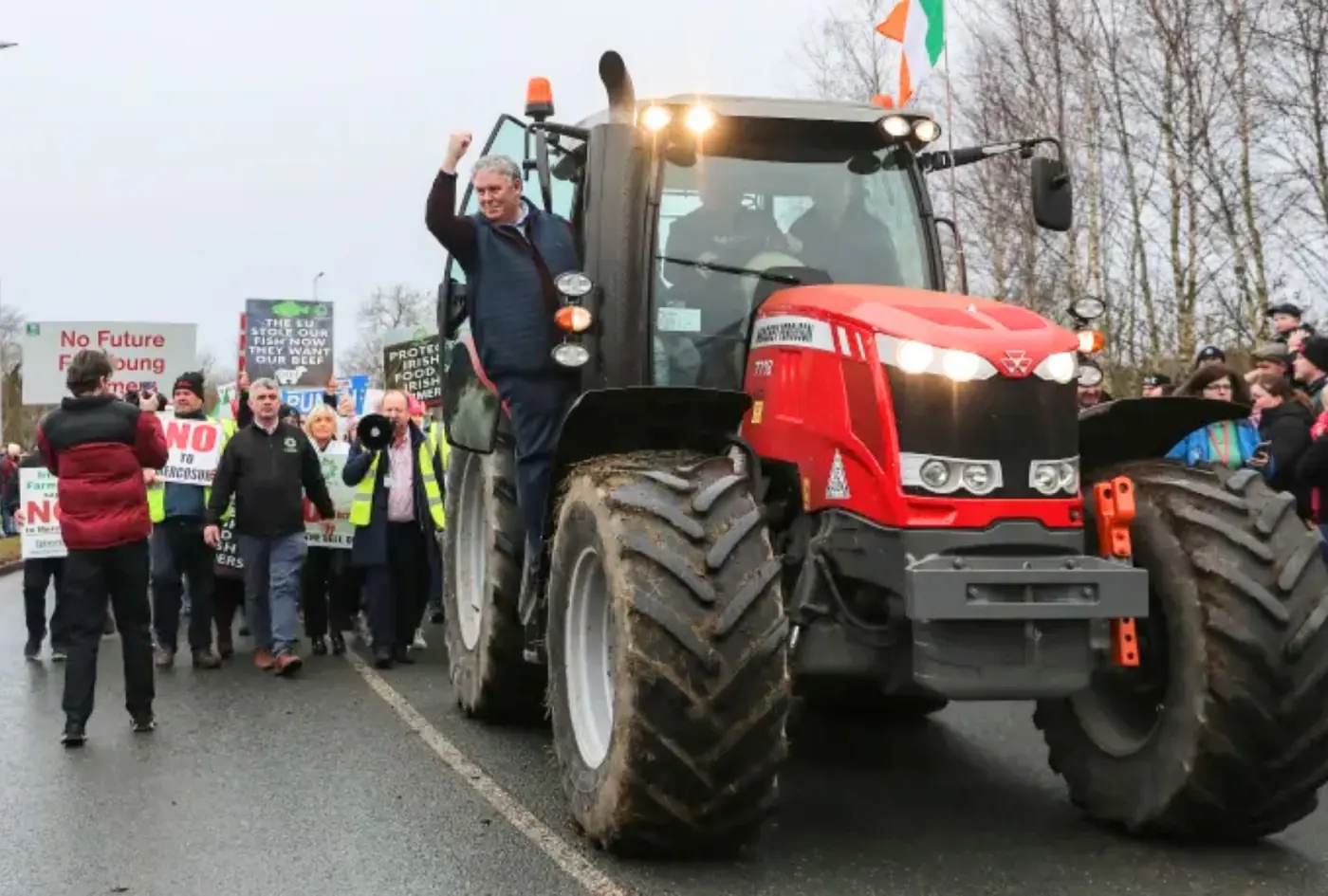 Office of Ciaran Mullooly MEPJoining a farmers’ protest march on a tractor
Speaking at the protest in Athlone organised by Independent Ireland and supported by the Irish Farmers’ Association, Ciaran told the crowd that the fight against the EU– agreement had moved to the European Parliament, and that MEPs from other member states had assured him it was not over despite the vote among national governments. The event drew, by the organisers’ estimate, more than 20,000 people to the International Athletics Arena at the Technological University of the Shannon, from Malin to Mizen Head.
His message was about where decisions now sit. Trade policy is an exclusive competence of the European Union, negotiated by the Commission under a mandate from the of national ministers. Once the Council has taken its position, the remaining decision belongs to the European Parliament, which must give its consent before an agreement can enter into force. Parliament cannot amend a trade deal; it approves or rejects the text as negotiated. That makes the consent vote absolute in a way that few parliamentary votes are.
He told the crowd that colleagues from other delegations had told him the battle in the Parliament was still live. That was not a rhetorical flourish — farm organisations in France, Poland, Italy and Romania had been organising in parallel, and the members who represent those regions were under the same pressure as Irish MEPs. The strategy that followed built directly on it: a letter to every Irish MEP, approaches to wavering members from Italy and France, a petition of more than 30,000 names delivered to the Commission, and a push to get a request for a Court of Justice opinion onto the agenda.
What is in the agreement
Mercosur is a South American customs union made up of Brazil, Argentina, Paraguay and Uruguay, with Bolivia acceding. After more than two decades of negotiation, political agreement with the European Union was reached at the end of 2024. Tariffs would fall in both directions. European carmakers, machinery firms and chemical producers gain access to a large and heavily protected market. In exchange, South American agricultural produce enters Europe on much better terms, including a substantial tariff-rate quota for beef at a greatly reduced duty.
A tariff-rate quota means a fixed volume admitted at a low rate, with the normal tariff applying above it. The volume matters less than where it lands: beef is a commodity market, and a quantity of imported product entering at the lower end of the price range affects the price paid for cattle across the whole market, not only for the cuts directly displaced. That is why the suckler counties of the west and midlands turned out in Athlone in January.
The other objection concerns standards. European producers work under rules on veterinary medicines, animal welfare, traceability and environmental compliance that add cost to every animal. Growth promoters prohibited in the European Union are used in beef production in Mercosur countries. On 21 January, days after the Athlone protest, the Parliament voted by 334 to 324 to ask the Court of Justice for an opinion on the agreement.
Read moreConnacht Tribune
Source: TheJournal.ie, 21 January 2026. Seat layout is illustrative.
The Commission negotiates trade agreements on behalf of all 27 member states. National governments approve them in the Council, and the European Parliament must give its consent. “Mixed” agreements, which cover areas where member states keep powers, must also be ratified by every national parliament.
For Mercosur, the Commission split the deal into an interim trade agreement and a separate partnership agreement, so the trade part would not need ratification by national parliaments. In January 2026 the Parliament voted 334–324 to ask the Court of Justice whether that approach is lawful.
Related.
 Mullooly Matters
: From the Cavan Farm to Brussels, Sophie Bell on Farming’s Future
The new episode of Ciaran’s weekly podcast features Sophie Bell, a young farmer from Virginia, Co. Cavan, on farming’s future.
 Diliff, CC BY-SA 3.0, Wikimedia Commons
‘UK must ban Brazilian beef next’: Ciaran welcomes the EU–UK food and agriculture agreement
Ciaran welcomed the conclusion of negotiations on a new EU–UK agreement on food, agriculture, animals and plants, due to apply from 1 March 2028, and called for strong food-safety safeguards and no gaps for third-country imports.
 Wikimedia Commons
Ciaran tells ICOS: no change to animal transport rules, and they must take Ireland’s position into account
Ciaran, a full member of the AGRI Committee, met ICOS in the European Parliament for an update on the Commission’s proposed changes to EU animal transport rules. No changes have been agreed by Parliament’s Agriculture or Transport committees.