Rural Ireland being left behind without proper digital infrastructure
In the final days of the European election campaign, Ciaran said rural Ireland was being left behind for want of proper digital infrastructure.
In the closing days of the European election campaign, Ciaran argued that rural Ireland was being left behind for want of proper digital infrastructure, and that the problem needed attention immediately rather than at the end of a long rollout schedule. His central complaint was about pace: the National Broadband Plan’s timetable, he said, was too drawn out for a country that has become dependent on connectivity for the ordinary business of daily life.
That dependence is not theoretical. Farm payment applications, herd registrations and nitrates records are filed online. School work is set and submitted online. Medical appointments, banking, tax returns, planning submissions and the applications for the European funding schemes that support rural communities all now assume a connection that works. A household without one is not merely inconvenienced; it is progressively excluded from services that used to be available over a counter in the nearest town.
What the National Broadband Plan is
The National Broadband Plan is the State intervention designed to bring high-speed connections to the parts of the country that commercial operators would not serve on their own. It covers roughly a quarter of premises in Ireland — around half a million homes, farms and businesses — spread across the areas where the cost of laying fibre to each dwelling is far higher than the revenue it will ever generate. The premises involved are concentrated in exactly the counties of Midlands–North-West: Donegal, Leitrim, Roscommon, Mayo, Cavan and the rest of the western and midland belt where population density is lowest.
The plan is delivered over a period of years, area by area, and the sequence in which an area is reached determines whether a household waits one year or seven. For a family deciding whether a young person can work remotely from home rather than emigrate to Dublin or abroad, or for a small business deciding where to locate, that timetable is the whole question.
The European dimension
The European Union has set out targets under its Digital Decade programme for gigabit connectivity to be available to all households and 5G coverage in all populated areas by 2030, and it has connected digital infrastructure to its wider objectives on cohesion and territorial balance. Several funding instruments can support it, including cohesion policy, the Connecting Europe Facility and the recovery and resilience funds, and state aid rules determine when a government may lawfully subsidise a network in an area where a commercial operator might otherwise invest.
Mobile coverage is the other half of the picture, and in the hillier and more remote parts of the north-west it remains patchy enough that a call can drop between one townland and the next. Ciaran has consistently linked this to the wider argument he has made since his election about place-based funding: that decisions taken centrally tend to favour places that already have population density, and that rural counties need the infrastructure first if they are to generate the activity that would justify it. He went on to win the fifth seat in Midlands–North-West and to take a place on the Parliament’s Regional Development Committee, which is responsible for the funds that pay for infrastructure of this kind.
Read moreHighland Radio
Source: Westmeath Examiner, 28 July 2025.
SMEs make up 99% of businesses in the EU. EU rules on the Single Market, trade, State aid and transport shape their costs, and programmes such as LEADER, InvestEU and the agri-food promotion policy can help them grow.
Ciaran is shadow rapporteur on the EU’s agri-food promotion rules, working to widen access for small producers.
Related.
Ciaran: men find it hardest to talk openly about loneliness
Ahead of a European Parliament event on social isolation, loneliness, anxiety and addiction, Ciaran said men, and older men in particular, struggle most to speak openly about loneliness, and that public figures should speak up.
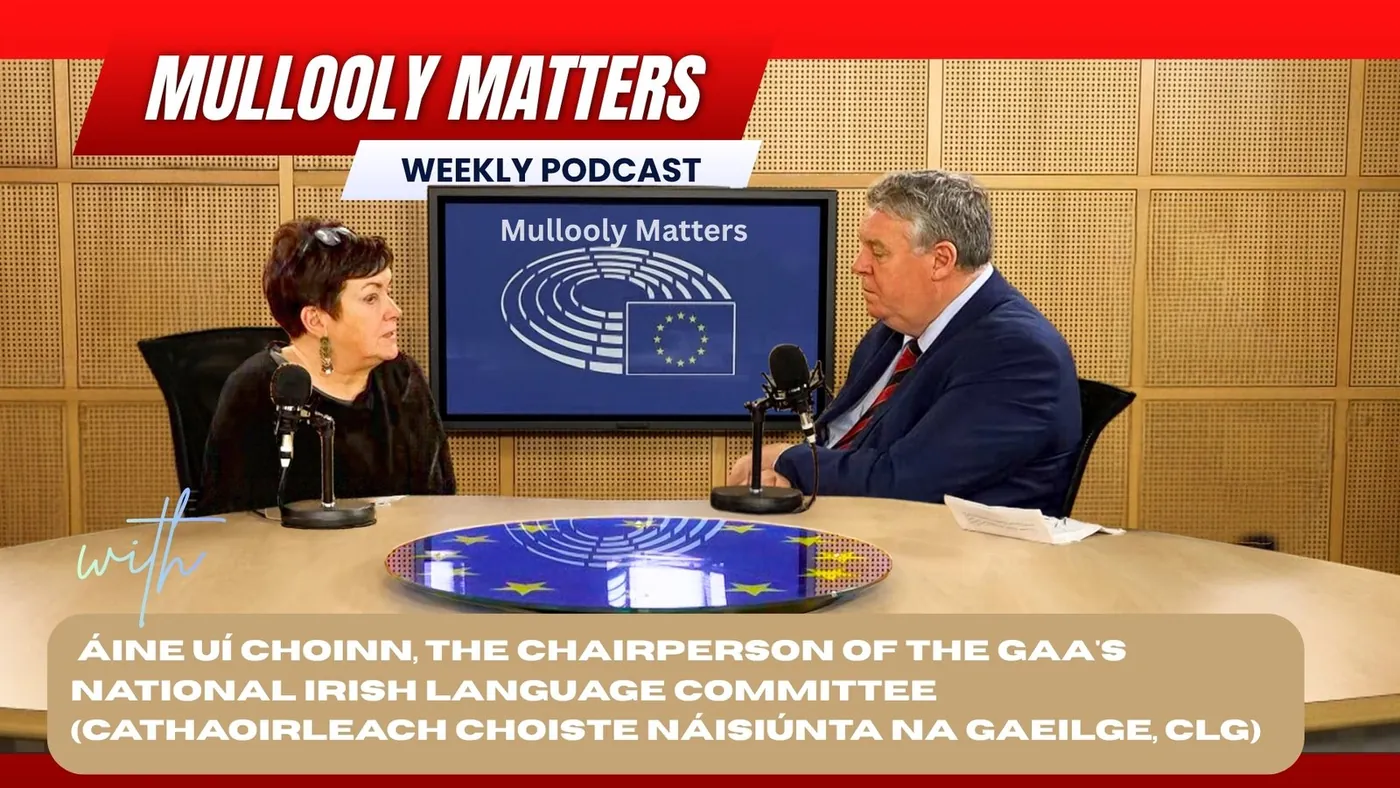 Mullooly Matters
: The Right to Stay – Can Rural Women Build a Future at Home?
Recorded in Brussels during Gender Equality Week, Ciaran talks to Áine Uí Choinn, chairperson of the GAA’s National Irish Language Committee, about what it would take for women and young people to build a life in rural Ireland and stay.
“Absurd costs”: Ciaran presses for packaging rules to be suspended for small businesses
Ciaran backed proposals to suspend EU packaging rules for small and micro businesses and asked the Commission for immediate clarity while negotiations continue. Some regional businesses, he said, face bills of thousands of euro.