Call for a dedicated EU Accessibility Agency
Ciaran called on the European Commission to establish a dedicated EU Accessibility Agency and to strengthen accessibility standards in transport and media.
Ciaran called on the European Commission to establish a dedicated EU Accessibility Agency and to strengthen the accessibility standards that apply to transport and to media. His argument was that the Union has legislated extensively in this area over the past decade but has no single body responsible for seeing that the legislation produces a difference in the lives of disabled people.
The European Union already has a considerable body of accessibility law. The Web Accessibility Directive requires public sector websites and mobile applications to meet defined standards. The European Accessibility Act, which applies from 2025, sets requirements for a range of products and services including banking, e-commerce, e-books, ticketing machines and telephony. Regulations on passenger rights cover assistance for disabled travellers on rail, air, bus and ferry services. The Audiovisual Media Services Directive requires member states to improve the accessibility of broadcast content through subtitling, audio description and sign language.
What is missing, in Ciaran’s account, is enforcement capacity and a single point of responsibility. Each of those instruments is implemented separately by each member state, monitored by different national bodies, and reported on through different channels. A disabled passenger who cannot board a train in Sligo, or a viewer who cannot follow a broadcast without subtitles, has no obvious European address to complain to, and there is no institution whose job it is to compare performance between member states and publish the results.
What an agency would do
The Union has created specialised agencies in many fields — food safety, medicines, aviation safety, fundamental rights, disease control — precisely where technical monitoring and consistent application across twenty-seven member states are needed. An accessibility agency on that model would gather data, develop and maintain technical standards, audit implementation and support member states that are behind. It would not replace national enforcement, but it would make national performance visible, which is generally the precondition for improvement.
The legal foundation for the argument is already in place. The European Union is a party in its own right to the United Nations Convention on the Rights of Persons with Disabilities, which obliges it to take measures to ensure access on an equal basis to the physical environment, transport, information and communications. The Union has a Strategy for the Rights of Persons with Disabilities running to 2030, and has introduced the European Disability Card to make recognition of disability status portable between member states.
In rural constituencies the practical stakes are higher than in cities. Where public transport is infrequent and stations are unstaffed, an inaccessible service is not an inconvenience but an exclusion, and the alternative — a car, adapted if necessary — is expensive. Ciaran has connected the accessibility argument to his housing work as well, arguing for simpler planning permission for independent-living accommodation so that disabled people are not left living in nursing homes for want of anywhere else to go.
Read moreMidlands 103
The EU is a party to the UN Convention on the Rights of Persons with Disabilities. Its Accessibility Act sets rules for products and services, and EU funds can support the move from institutional to community-based care.
Parliament’s Disability Intergroup brings MEPs from all groups together on these issues. Ciaran sits on its bureau for Renew Europe.
Related.
Ciaran: men find it hardest to talk openly about loneliness
Ahead of a European Parliament event on social isolation, loneliness, anxiety and addiction, Ciaran said men, and older men in particular, struggle most to speak openly about loneliness, and that public figures should speak up.
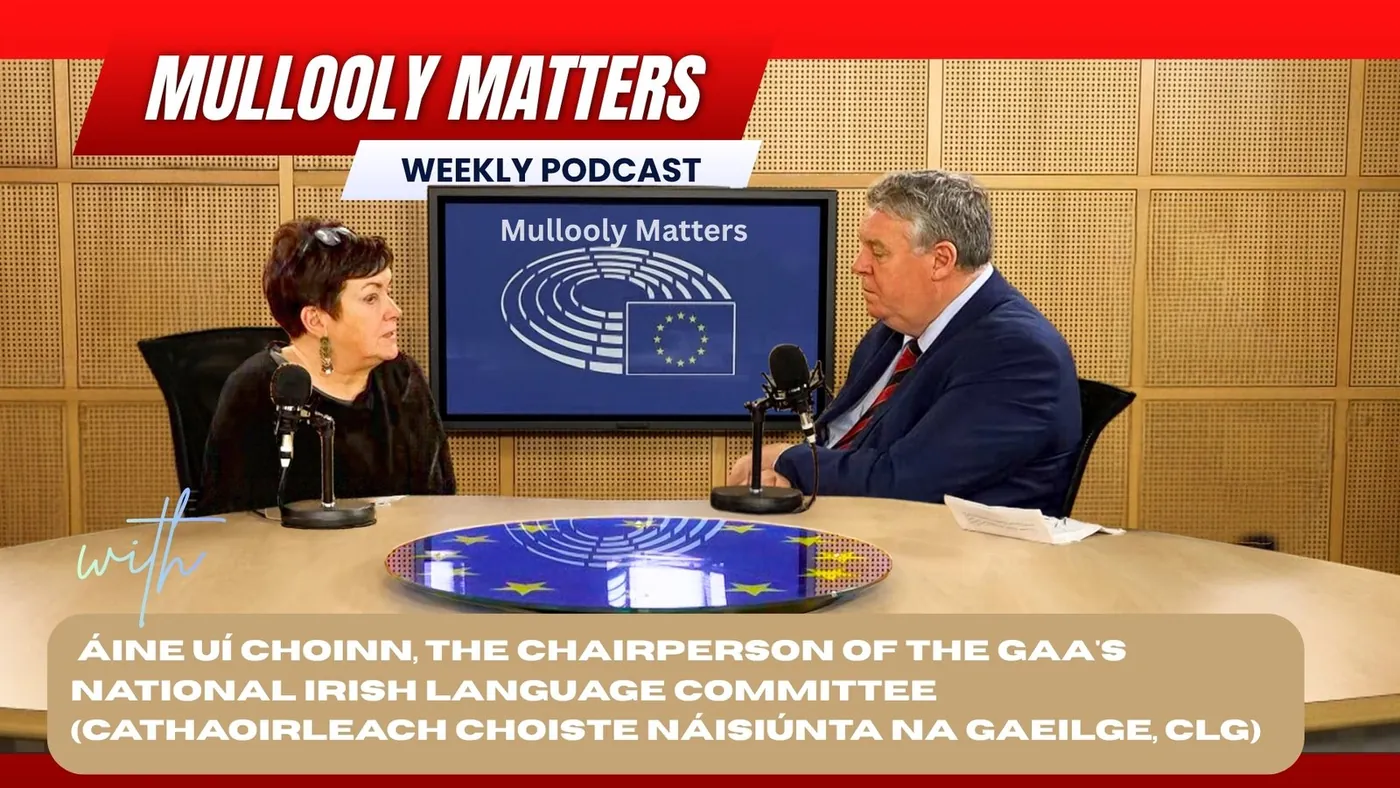 Mullooly Matters
: The Right to Stay – Can Rural Women Build a Future at Home?
Recorded in Brussels during Gender Equality Week, Ciaran talks to Áine Uí Choinn, chairperson of the GAA’s National Irish Language Committee, about what it would take for women and young people to build a life in rural Ireland and stay.
“Every woman deserves a pathway to safety and freedom”
After the latest update from Women’s Aid’s Femicide Watch, Ciaran called for urgent action to protect women experiencing domestic violence.