Reform the Disability Allowance means test during Ireland’s EU Presidency
Ahead of the informal EU employment and social affairs ministers’ meeting in Ballina, Ciaran urged Minister Dara Calleary to reform the Disability Allowance means test, which he said discourages people with disabilities from taking up full-time work.
Ahead of the informal meeting of European Union employment and social affairs ministers in Ballina, Ciaran urged the Minister, Dara Calleary, to reform the means test attached to Ireland’s Disability Allowance, which he said discourages people with disabilities from taking up full-time work.
The problem he described is one of the oldest in social protection design. Disability Allowance is a means-tested payment, and earnings above a modest threshold reduce it. Because the payment also carries entitlements that matter a great deal — a medical card, travel and household benefits — the effective loss from taking a full-time job can approach or exceed the wage gained. The result is a strong financial disincentive to work more hours, applied to a group whose employment rate is already far below the general population.
Ireland’s employment rate among people with disabilities has consistently been among the lowest in the European Union. The reasons are not confined to the benefit system — transport, accessible workplaces, employer attitudes and the availability of personal assistance all play a part — but the means test is the element that is straightforwardly within the power of a government to change, and it is the one campaigners have returned to for years. Proposals have included raising the earnings disregard, tapering withdrawal more gradually, and decoupling secondary benefits such as the medical card from the payment itself so that a person does not lose healthcare by taking a job.
Why raise it at a Ballina meeting
Informal councils are a feature of the rotating Presidency. The member state holding the chair invites ministers from all twenty-seven to meet outside Brussels, usually in a regional location, for discussions without formal decisions on the agenda. They are used to set direction and to build consensus on subjects that are not yet ripe for legislation. Holding one in Ballina brought European social affairs ministers to County Mayo, which is within the constituency Ciaran represents, and gave a domestic issue an unusually well-timed European audience.
The European framework is supportive rather than binding. The Union has a Strategy for the Rights of Persons with Disabilities, all member states and the Union itself are parties to the United Nations Convention on the Rights of Persons with Disabilities, and the European Pillar of Social Rights includes commitments on inclusion and on income support. None of these instruments determines the rate of an Irish payment or the design of an Irish means test, which remain matters for the Oireachtas and the Department of Social Protection. What they provide is a standard against which national arrangements can be measured, and a forum in which a minister can be asked why his country compares as it does.
Ciaran’s argument was framed as a Presidency opportunity rather than a complaint. A country chairing the for six months is in a position to lead by example on the themes it chooses to prioritise, and reform that allows people with disabilities to work without losing the supports they depend on is one that other member states have already attempted in various forms. The decision remains a national one.
Read moreMidwest Radio
The EU is a party to the UN Convention on the Rights of Persons with Disabilities. Its Accessibility Act sets rules for products and services, and EU funds can support the move from institutional to community-based care.
Parliament’s Disability Intergroup brings MEPs from all groups together on these issues. Ciaran sits on its bureau for Renew Europe.
Related.
Ciaran: men find it hardest to talk openly about loneliness
Ahead of a European Parliament event on social isolation, loneliness, anxiety and addiction, Ciaran said men, and older men in particular, struggle most to speak openly about loneliness, and that public figures should speak up.
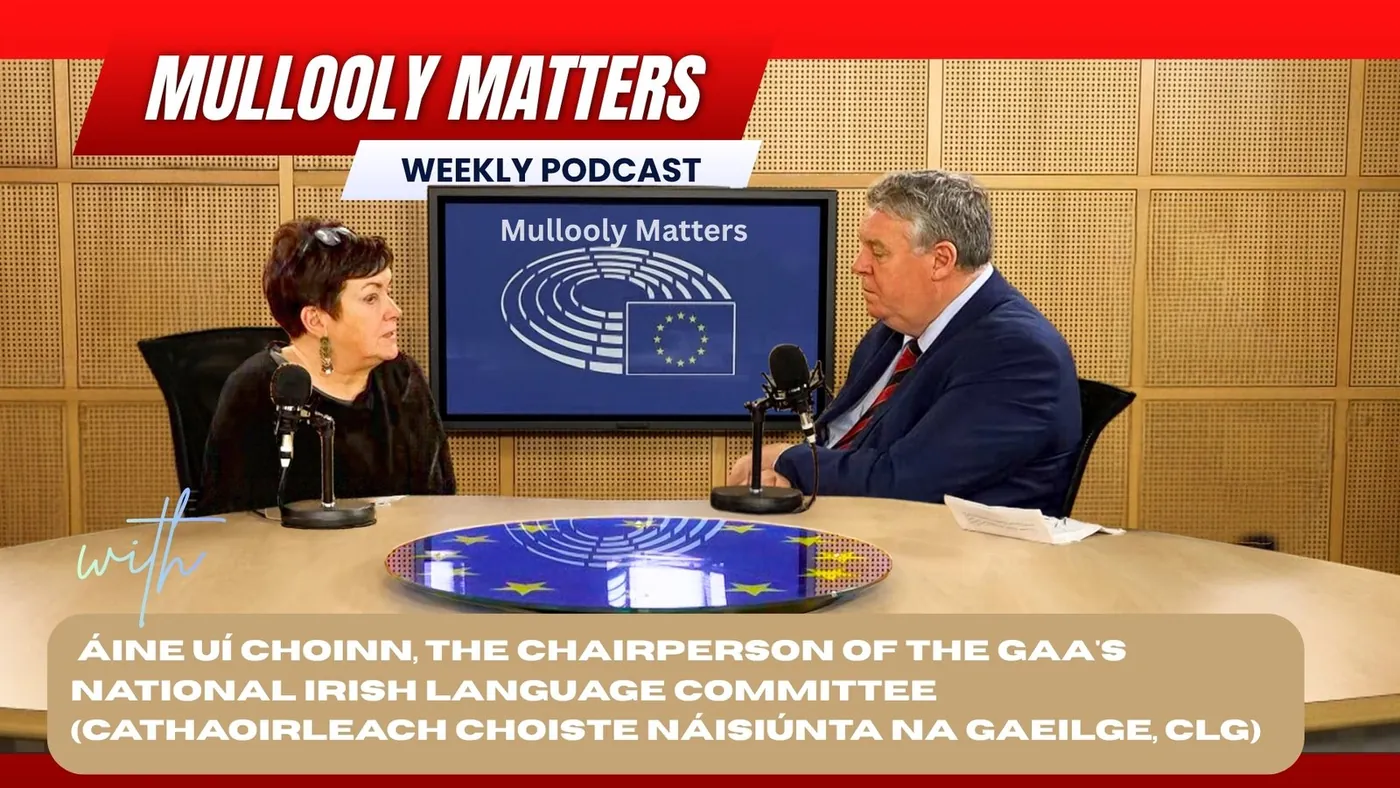 Mullooly Matters
: The Right to Stay – Can Rural Women Build a Future at Home?
Recorded in Brussels during Gender Equality Week, Ciaran talks to Áine Uí Choinn, chairperson of the GAA’s National Irish Language Committee, about what it would take for women and young people to build a life in rural Ireland and stay.
“Every woman deserves a pathway to safety and freedom”
After the latest update from Women’s Aid’s Femicide Watch, Ciaran called for urgent action to protect women experiencing domestic violence.