Commissioner Hansen agrees consumers need clearer food origin information, as Ciaran presses the case
At the Agriculture Committee, Ciaran asked how EU-funded promotion can make European origin clear while keeping Irish origin visible. Commissioner Christophe Hansen said European products “need to be visible” and that the gap Ciaran has raised is real.
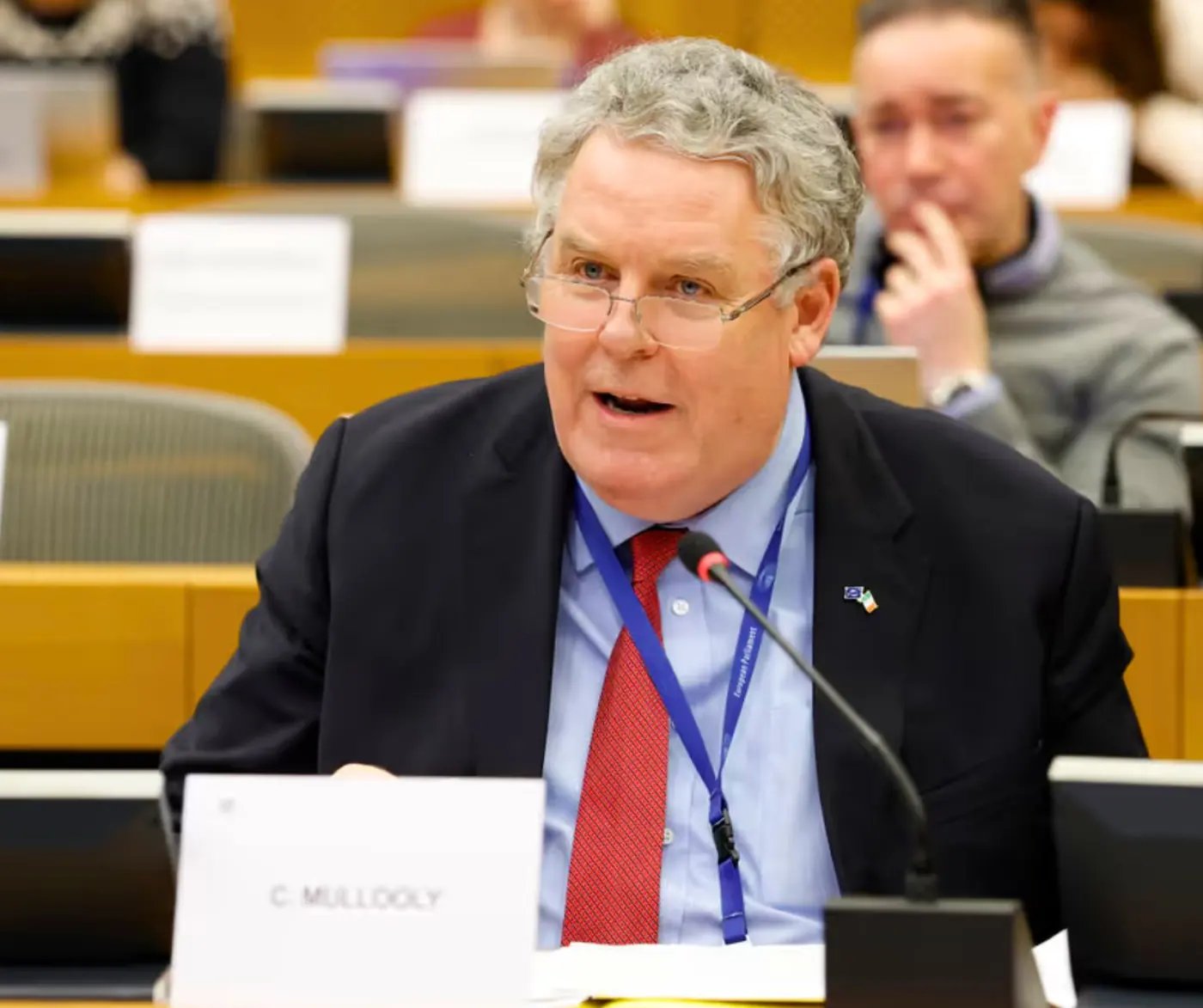 Office of Ciaran Mullooly MEPSpeaking in an Agriculture Committee session, European Parliament
Ciaran’s long-running campaign to close the loopholes in country-of-origin labelling has won the attention of Agriculture Commissioner Christophe Hansen. At the latest meeting of the European Parliament’s Agriculture Committee, the two agreed that EU policy should give consumers clearer information when they choose what food to buy.
Ciaran, who is Renew Europe’s on the revision of the EU Organic Regulation, put a direct question to the Commissioner: “Consumers must be able to distinguish European produce from imported food. How will EU-funded promotion make European origin clear, while keeping national identities, including Irish origin, visible alongside EU and quality labels?”
Commissioner Hansen answered: “If it is a European product, it needs to be visible.” He also named the information gap that Ciaran has been raising: “You will be able to see where it is processed, but you will not be able to see where the main component, the meat, is coming from.” Consumers, he said, are interested in knowing whether a product is European, and “we need to make a lot of work” to make that clearer.
Why origin matters to consumers
Ciaran told the committee that consumers need to know the country where a product was produced. That information helps people understand the standards and requirements that applied in production, including animal welfare and food safety. Saying only where a product was processed or packaged, he argued, does not give shoppers enough to make a fully informed choice.
“Consumers matter. Knowing where a food product was produced, whether it is organic or not, is not an optional extra. It is essential information that people need to make an informed decision about the food they buy.”
The Commissioner referred directly to Ciaran’s work on the Organic Regulation, saying that, on bureaucracy, Ciaran had made proposals in the Organic Regulation too, and that stakeholders had raised concerns about additional administrative burdens.
This follows the negotiations on the Organic Regulation, after which the Commission and committed to prioritise country-of-origin labelling in future work on the EU livestock strategy. Ciaran welcomed that commitment as progress, while saying he is disappointed at the pace of change. He has said that descriptions such as “EU agriculture” or “non-EU agriculture” are too vague.
Public procurement: a chance for better food in schools and hospitals
Ciaran also welcomed changes to EU procurement policy. Commissioner Hansen said the proposed Public Procurement Act would allow buyers to consider food quality and sustainability, including for organic, local and regional products. “I was very strongly arguing that we have a specific article on food in this public procurement proposal. We are the only sector that got it. And I think I can tell you that it was a strong fight behind the scenes to get that.”
Hansen put the scale of public food purchasing at about 55 billion euros a year across the EU, in schools, hospitals and elsewhere, where until now price was the only criterion. “It is important that we take as well the quality criteria therein for organic, for local, regional products with less transport and so on. And I think that is very important. That will give as well a boost to our sector.”
The proposal is not yet law, and it does not require buyers to choose food on the basis of its country of origin. Ciaran has said he will keep pressing for clear and practical origin labelling.
The campaign so far
Ciaran had earlier written again to Commissioner Hansen, as Agriland reported, seeking clear country-of-origin labelling for imported beef, and equivalent transparency rules for imports so that European farmers compete on a “level playing field”. He welcomed the Commissioner’s “positive response”, in which Hansen said the Commission shares the objectives of better consumer information, traceability and confidence in the food chain, calling it “an important first step”. He urged the Commission to set a clear legislative timetable for “meaningful reform” and to tackle origin labels that are “too vague” for non-EU products.
Read moreAgriland
Sources: Commission CAP proposal; AGRI Committee; Roscommon People, 30 June 2026; Midwest Radio, 5 May 2026; CSO Farm Structure Survey 2023.
The CAP is the EU’s farm policy and one of its largest budget lines. It pays direct supports to farmers (Pillar 1) and funds rural development, including agri-environment schemes, young farmer supports and LEADER (Pillar 2).
The next CAP will run from 2028 to 2034. The Commission has proposed merging it into single national and regional plans, which would end its ring-fenced budget. Parliament’s Agriculture Committee, where Ciaran is a full voting member, is now amending the proposals before negotiations with national governments.
Related.
 Mullooly Matters
: From the Cavan Farm to Brussels, Sophie Bell on Farming’s Future
The new episode of Ciaran’s weekly podcast features Sophie Bell, a young farmer from Virginia, Co. Cavan, on farming’s future.
 Diliff, CC BY-SA 3.0, Wikimedia Commons
‘UK must ban Brazilian beef next’: Ciaran welcomes the EU–UK food and agriculture agreement
Ciaran welcomed the conclusion of negotiations on a new EU–UK agreement on food, agriculture, animals and plants, due to apply from 1 March 2028, and called for strong food-safety safeguards and no gaps for third-country imports.
 Wikimedia Commons
Ciaran tells ICOS: no change to animal transport rules, and they must take Ireland’s position into account
Ciaran, a full member of the AGRI Committee, met ICOS in the European Parliament for an update on the Commission’s proposed changes to EU animal transport rules. No changes have been agreed by Parliament’s Agriculture or Transport committees.