In the AGRI Committee, Ciaran presses Minister Heydon on origin labelling and Brazilian beef
When Agriculture Minister Martin Heydon appeared before the Agriculture Committee, Ciaran sought agreement on “unambiguous, large and legible” country-of-origin labelling, raised Brazilian beef, and argued against age-based restrictions on CAP payments.
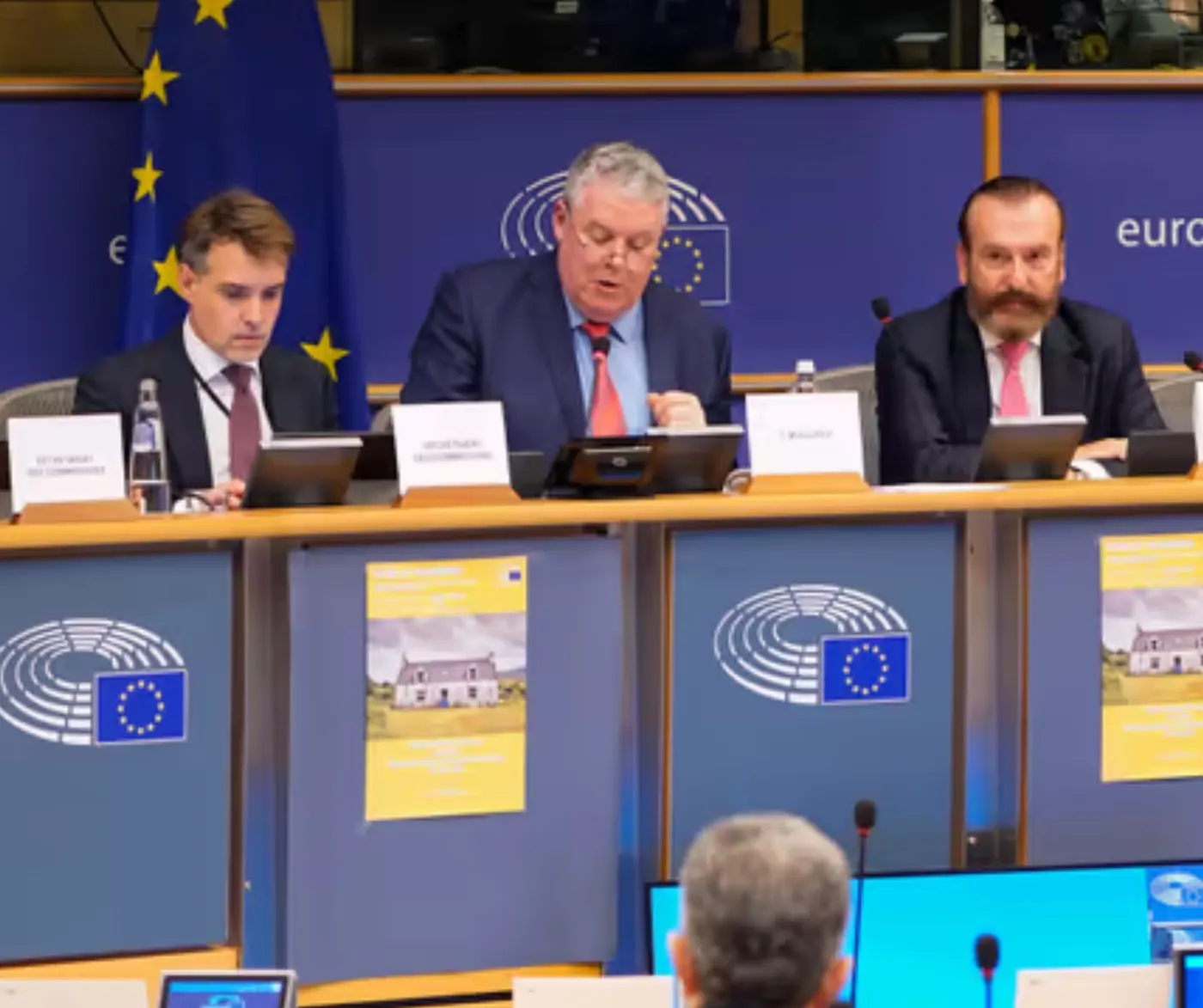 Office of Ciaran Mullooly MEPIn a European Parliament committee session
When the Minister for Agriculture, Martin Heydon, appeared before the European Parliament’s Agriculture Committee, Ciaran used his allotted time to press him on three things: agreement on country-of-origin labelling that is unambiguous, large and legible; the question of Brazilian beef; and his opposition to restricting Common Agricultural Policy payments on the basis of a farmer’s age.
Ministers appear before the committee when their country holds the rotating Presidency of the of the European Union, which passes between member states every six months. The Presidency chairs the Council’s negotiations and sets much of its agenda, so the minister of the day is not merely a national politician visiting Brussels but the chair of the body the Parliament must ultimately negotiate with. That is what gives the session its weight: an MEP is putting a request to the person who will hold the pen on the Council side.
The labelling argument
Country-of-origin rules in the European Union are a patchwork. Fresh beef must carry details of where the animal was born, reared and slaughtered, a system introduced after the BSE crisis. Other products carry much less. Processed foods can be described in terms that convey very little — Ciaran has repeatedly pointed to formulations along the lines of made with EU and non-EU ingredients, which tells a shopper almost nothing about where an animal was actually raised. He has pushed the Commission for clearer country-of-origin labelling requirements, and his standard is a practical one: text a person can read without effort at the point of sale.
The Brazilian beef question connected the two subjects. The Commission removed Brazil from the list of countries authorised to export beef to the Union after Brazil failed to demonstrate compliance with European requirements on antibiotic and hormone use. Ciaran has argued throughout that the objection is to a standard rather than to a country, and that without clear labelling consumers cannot exercise any judgement of their own about where their food comes from.
On age-based restrictions, the proposal at issue would limit or taper direct payments to farmers above a certain age, on the reasoning that it would encourage generational renewal by making it less attractive to hold onto land into old age. Ciaran argued against it. The Irish objection is that a very large number of holdings are farmed by people who are also drawing a pension, or by families where the land is worked jointly across generations without a formal transfer having taken place, and that a blunt age rule would cut income from working farms without producing the succession it is meant to encourage. His alternative approach has been to fund the incentive rather than impose the penalty, which is why he tabled amendments to raise the share of the budget reserved for young farmers to ten per cent.
Nothing is decided in an exchange of that kind. What it does is put a specific request to the Presidency in public and on the record, so that the answer can be quoted back when the Council position on these files is eventually agreed.
Read moreRoscommon People Agriland
Sources: Commission CAP proposal; AGRI Committee; Roscommon People, 30 June 2026; Midwest Radio, 5 May 2026; CSO Farm Structure Survey 2023.
The CAP is the EU’s farm policy and one of its largest budget lines. It pays direct supports to farmers (Pillar 1) and funds rural development, including agri-environment schemes, young farmer supports and LEADER (Pillar 2).
The next CAP will run from 2028 to 2034. The Commission has proposed merging it into single national and regional plans, which would end its ring-fenced budget. Parliament’s Agriculture Committee, where Ciaran is a full voting member, is now amending the proposals before negotiations with national governments.
Related.
Ciaran hosts a European conference on island communities and the “Right to Stay” in Longford
“Sustainable Development, Depopulation and Connectivity for EU Islands: Challenges, Opportunities and the Right to Stay”, on Friday 27 November at Longford Rugby Club, 10am to 2:30pm. Free, with limited places.
 Mullooly Matters
: From the Cavan Farm to Brussels, Sophie Bell on Farming’s Future
The new episode of Ciaran’s weekly podcast features Sophie Bell, a young farmer from Virginia, Co. Cavan, on farming’s future.
 Diliff, CC BY-SA 3.0, Wikimedia Commons
‘UK must ban Brazilian beef next’: Ciaran welcomes the EU–UK food and agriculture agreement
Ciaran welcomed the conclusion of negotiations on a new EU–UK agreement on food, agriculture, animals and plants, due to apply from 1 March 2028, and called for strong food-safety safeguards and no gaps for third-country imports.