Irish waters are not Brussels’ bargaining chip
Ciaran wrote to the Taoiseach and Fisheries Commissioner Costas Kadis after reports that the EU could offer Iceland fisheries flexibility if it reopens accession talks, demanding written confirmation that Ireland has been consulted and that no arrangement affecting Irish waters proceeds without it.
Ciaran wrote to the Taoiseach and to the European Fisheries Commissioner, Costas Kadis, after reports that the European Union might offer Iceland flexibility on fisheries if it were to reopen accession negotiations. He sought written confirmation that Ireland had been consulted, and an assurance that no arrangement affecting Irish waters would proceed without Irish agreement.
“Ireland cannot again discover after the fact that its waters, quota or fishing opportunity have been used as EU negotiating currency.”
Iceland applied to join the European Union in 2009 and suspended the process in 2013, and fisheries were the principal obstacle. Fishing is central to the Icelandic economy and the country has historically been unwilling to hand control of its waters and quotas to a common policy administered from Brussels. Any revival of the accession question would therefore have to address fisheries first, and the concern Ciaran identified is that an accommodation offered to Iceland would have to be balanced somewhere within the existing allocation.
How European fisheries management works
Fishing in European Union waters is governed by the Common Fisheries Policy. Each year the International for the Exploration of the Sea, an independent scientific body, publishes advice on the state of the main commercial stocks. On that basis the Council of fisheries ministers sets total allowable catches — the maximum tonnage that may be taken of each stock — and those totals are then divided among member states according to fixed percentage shares known as .
Ireland has a particular grievance about how those shares work out. Irish waters are among the most productive in the Union and a very large share of the catch taken from them is landed by vessels from other member states. Ireland also carries a specific protection known as the , agreed in 1976, which provides for additional allocations to Ireland and to northern Scotland when stocks are low, in recognition of dependence on fishing in coastal communities. The Hague Preferences must be invoked and are contested by other member states each year, so they are a protection that has to be defended rather than one that applies automatically.
The recent history sharpens the anxiety. Under the Trade and Cooperation Agreement that followed the United Kingdom’s departure from the Union, quota shares were transferred to the United Kingdom, and the Irish fishing industry has argued consistently that Ireland bore a disproportionate share of that loss relative to other member states.
Accession is a matter for the applicant country, the Commission, the Council and ultimately the member states, each of which must ratify a treaty of accession. Ireland therefore has a veto at the final stage, but the substance of a fisheries arrangement would be settled long before that point, in negotiating chapters where the detail is agreed. Ciaran’s demand for written confirmation and consultation was aimed at that earlier stage, when positions are formed and are still capable of being changed. The fishing ports of Donegal, Sligo, Mayo and Galway, which lie within his constituency, are among the communities most exposed to the outcome.
Read moreThe Fishing Daily Afloat
Sources: ICES advice as reported by Donegal Live, 13 November 2025.
Under the Common Fisheries Policy, EU ministers set annual catch limits (total allowable catches) for each stock, based on scientific advice from ICES, and share them between member states using fixed keys based largely on historic catches from the 1970s.
The Hague Preferences, agreed in 1976, allow regions heavily dependent on fishing, including Ireland, to receive a larger share when quotas for key stocks are cut sharply. Ciaran has called for them to be invoked to protect Killybegs, Castletownbere and coastal communities.
Related.
 Wikimedia Commons
Future investment and reform essential in the fishing sector
Ciaran said Irish fishermen and coastal communities need greater investment, not further cuts, and that the fisheries budget must at the very minimum be fully restored. He said he has corrected his vote on a Left group amendment on the 2027 budget to reflect that position.
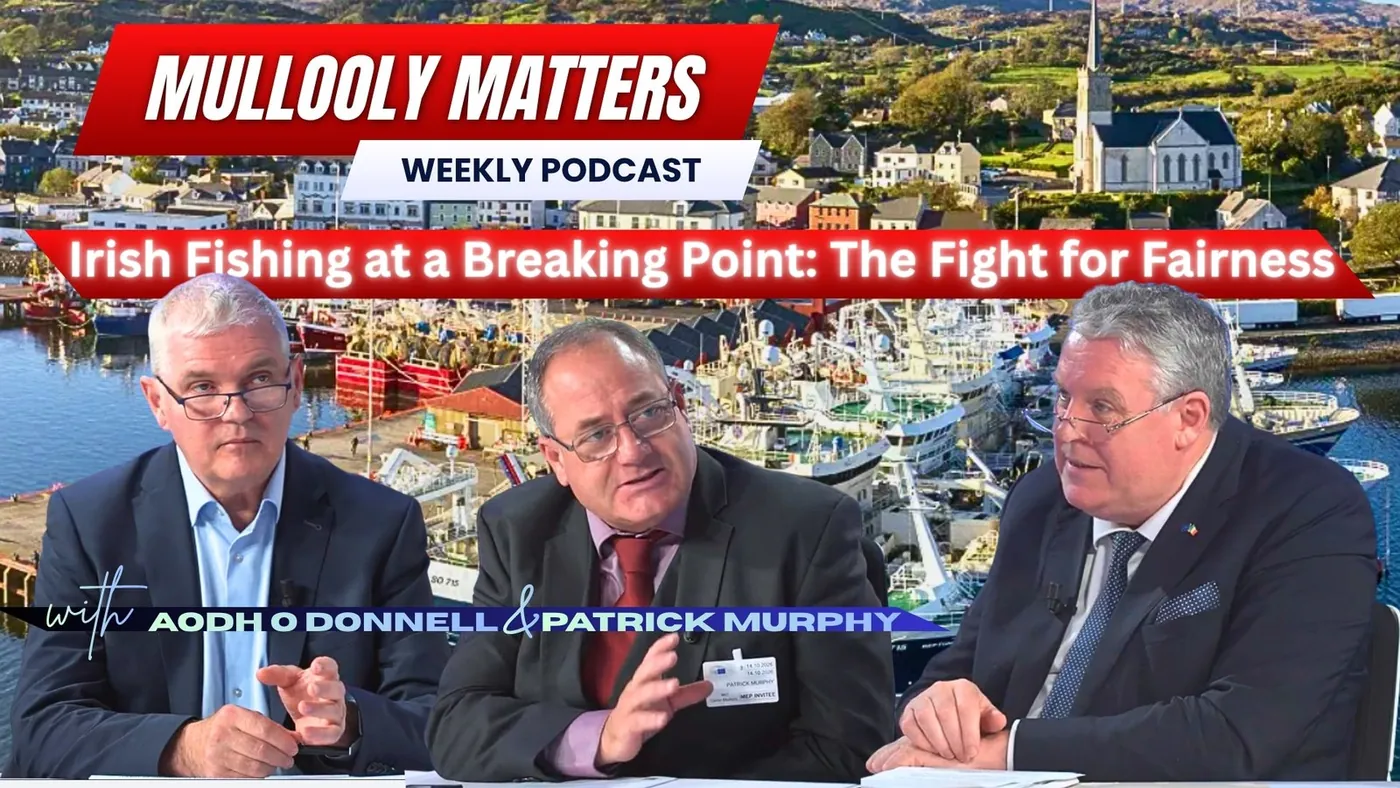 Mullooly Matters
: Irish Fishing at a Breaking Point, The Fight for Fairness
The new episode of Ciaran’s weekly podcast, with Aodh Ó Donnell of the Irish Fish Producers’ Organisation and Patrick Murphy of the Irish South and West Fish Producers’ Organisation, on the state of the Irish fishing industry.
Supporting the King of the Lake International Pike Festival on Lough Ree
Ciaran was thanked by the Lough Ree Angling Hub, alongside Roscommon and Longford county councils, for supporting its biggest ever international pike festival.