Killybegs fishermen tied up while foreign boats fish freely
Ciaran highlighted the injustice of Irish vessels tied up in Killybegs while foreign fleets continue to fish in Irish waters.
In late November 2024, in one of his earliest interventions on fisheries as an MEP, Ciaran Mullooly highlighted what he described as the injustice of Irish vessels lying tied up at the quay in Killybegs while foreign fleets continued to fish in Irish waters. The contrast — idle Irish boats, active foreign ones, in the same sea — has been the central grievance of the Irish fishing industry for most of the last decade, and Killybegs, as the country’s largest fishing port, is where it is most visible.
The structural cause lies in how European fishing opportunities are divided. Under the Common Fisheries Policy, each member state receives a fixed percentage share of the total allowable catch for each stock, and those shares were set in 1983 under the principle of , on the basis of historic catch records from a period when the Irish fleet was small. The result is that Ireland holds a share of the quota in its own exclusive economic zone that is far smaller than the proportion of the fish found there, and that vessels from other member states are legally entitled to take the balance.
Brexit then made it worse. The Trade and Cooperation Agreement of December 2020 transferred a share of EU quota to the United Kingdom, and the burden of that transfer fell disproportionately on Ireland — a point acknowledged by the Irish Government at the time and addressed, partially, through decommissioning schemes funded from the Brexit Adjustment Reserve. Boats tied up because the quota has run out, or because it is no longer economic to fish what remains, are the visible end of that arithmetic.
Alongside it sits the coastal states problem. Mackerel and blue whiting, the mainstays of the Killybegs pelagic fleet, migrate through the waters of Norway, the Faroe Islands, Iceland, Greenland, the UK and the EU. In the absence of an agreed sharing arrangement between those parties, unilateral quota-setting has pushed the combined catch well above the level scientists advise — so an Irish skipper observing a quota cut can reasonably ask what conservation purpose it serves.
Following the argument through
Ciaran has returned to each of these points since. He called in November 2025 for the — the 1976 commitment to give special consideration to Ireland and the north of Scotland when quotas fall to low levels — to be invoked to protect coastal communities. He sought answers on the EU–Iceland fisheries talks in June 2026, insisting that Irish waters are not Brussels’ bargaining chip. In the Fisheries Committee in February 2026 he pressed for Killybegs to be designated a control port and for help with the cost of monitoring obligations. And when the December 2025 Fisheries cut Ireland’s opportunities by 57,000 tonnes, he called the outcome a body blow and demanded emergency aid.
Read moreOcean FM
Sources: ICES advice as reported by Donegal Live, 13 November 2025.
Under the Common Fisheries Policy, EU ministers set annual catch limits (total allowable catches) for each stock, based on scientific advice from ICES, and share them between member states using fixed keys based largely on historic catches from the 1970s.
The Hague Preferences, agreed in 1976, allow regions heavily dependent on fishing, including Ireland, to receive a larger share when quotas for key stocks are cut sharply. Ciaran has called for them to be invoked to protect Killybegs, Castletownbere and coastal communities.
Related.
Future investment and reform essential in the fishing sector
Ciaran said Irish fishermen and coastal communities need greater investment, not further cuts, and that the fisheries budget must at the very minimum be fully restored. He said he has corrected his vote on a Left group amendment on the 2027 budget to reflect that position.
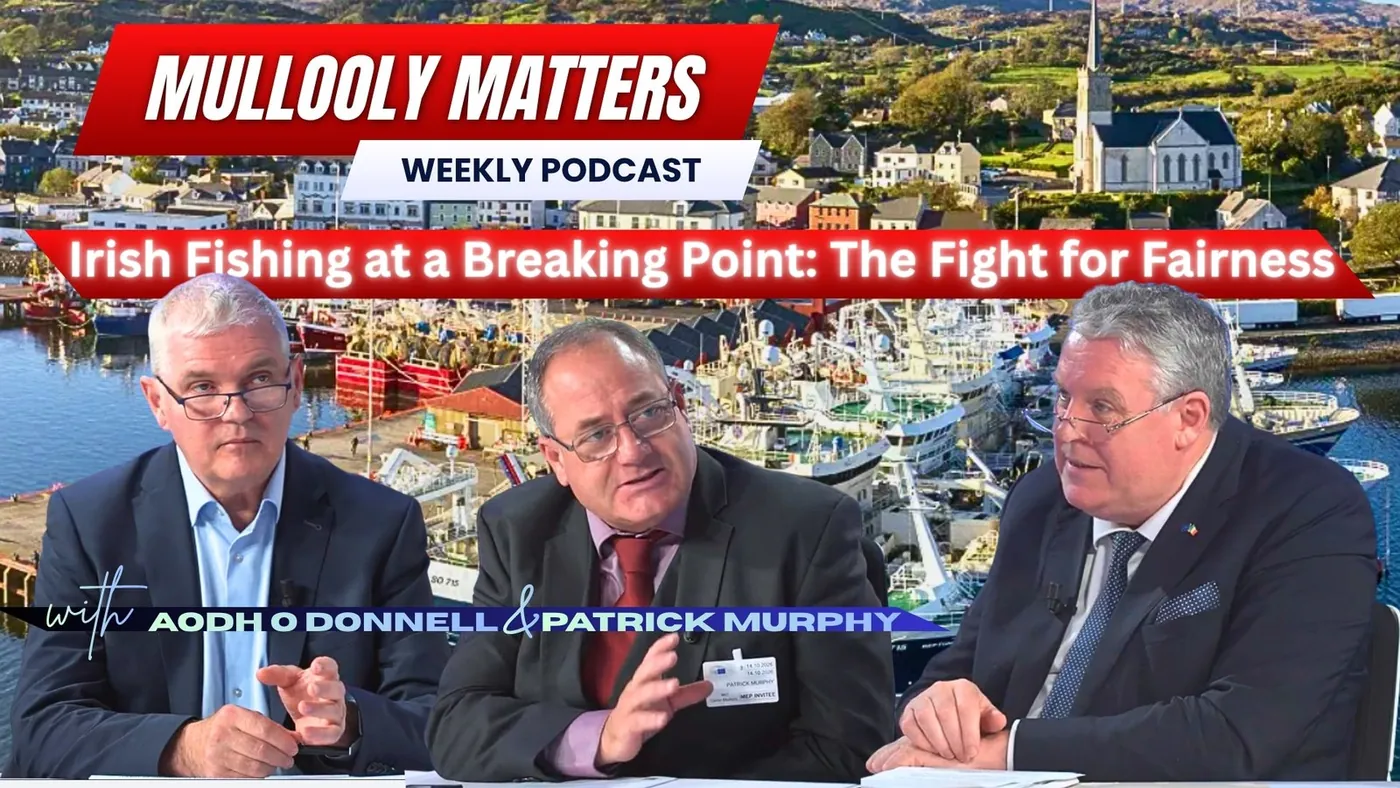 Mullooly Matters
: Irish Fishing at a Breaking Point, The Fight for Fairness
The new episode of Ciaran’s weekly podcast, with Aodh Ó Donnell of the Irish Fish Producers’ Organisation and Patrick Murphy of the Irish South and West Fish Producers’ Organisation, on the state of the Irish fishing industry.
Supporting the King of the Lake International Pike Festival on Lough Ree
Ciaran was thanked by the Lough Ree Angling Hub, alongside Roscommon and Longford county councils, for supporting its biggest ever international pike festival.