30,000-signature Mercosur petition delivered to the Commission President’s office
At the first AGRI Committee meeting of 2026, Ciaran asked colleagues whether they would allow Parliament to be sidestepped on Mercosur, and personally delivered a petition signed by more than 30,000 people to a member of Ursula von der Leyen’s staff.
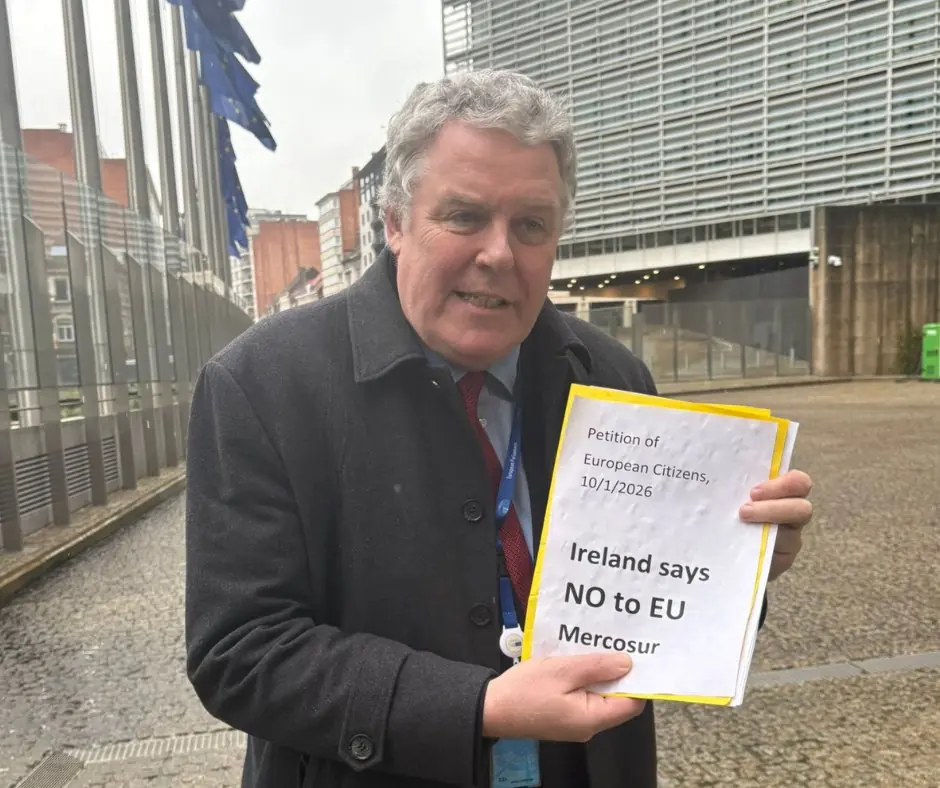 Office of Ciaran Mullooly MEPOutside the European Commission with the 30,000-signature petition against the EU–Mercosur deal
At the first meeting of the European Parliament’s Agriculture Committee of 2026, Ciaran put a direct question to his colleagues: would they allow the Parliament to be sidestepped on the agreement? The same day he walked to the Berlaymont and personally handed a petition signed by more than 30,000 people to a member of Commission President Ursula von der Leyen’s staff.
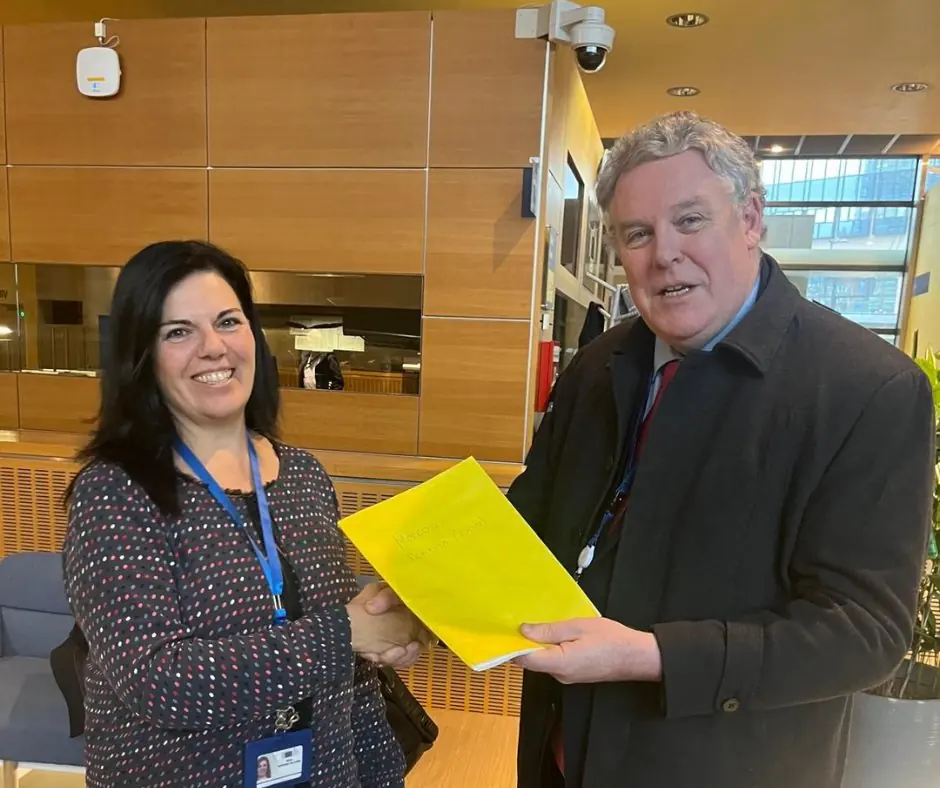 Office of Ciaran Mullooly MEP
The petition was the visible residue of the Athlone rally, where organisers estimated more than 20,000 people had gathered a few days earlier, and of the campaign around it. Petitions delivered to the Commission carry no formal legal status of their own — that is a separate procedure, through the Parliament’s Committee on Petitions — but they establish a documented level of public objection that officials must acknowledge receiving, and they make the political cost of proceeding harder to ignore.
The question he put to the Agriculture Committee went to the Parliament’s own standing rather than to the merits of the deal. The Commission had split the Mercosur package in two, separating the trade elements, which the European Union can conclude on its own, from a wider political agreement requiring ratification by national parliaments. Members who accepted that split without challenge would, on his argument, be accepting a precedent that narrows what the Parliament and national parliaments get to decide on future agreements.
Where the file stood
By January 2026 the argument had reached its decisive phase. A cross-party motion tabled the previous November had asked the Court of Justice whether the Commission broke EU law by dividing the agreement. The Parliament’s President had initially declined to table the resulting resolution, prompting a formal objection from Ciaran in in late November. Within days of the petition being delivered, the Parliament voted — 334 to 324 — to seek the Court’s opinion.
Mercosur consists of Brazil, Argentina, Paraguay and Uruguay, with Bolivia acceding. The agreement with the European Union, concluded politically at the end of 2024 after more than two decades of talks, would remove tariffs across a wide range of goods. European industry gains entry to a large protected market; in return South American agricultural produce, including a substantial tariff-rate quota for beef, enters Europe on far better terms than at present.
For the counties Ciaran represents the beef quota is the entire issue. The suckler herd is concentrated in the west and midlands, margins are narrow, and Irish producers comply with European rules on veterinary medicines, welfare and environmental standards that imported product does not have to meet. He also called on the Irish Commissioner, Michael McGrath, to intervene. The Court’s opinion, once delivered, will determine whether the agreement can proceed in the form the Commission proposed.
Read moreRoscommon Herald Roscommon People
Source: TheJournal.ie, 21 January 2026. Seat layout is illustrative.
The Commission negotiates trade agreements on behalf of all 27 member states. National governments approve them in the Council, and the European Parliament must give its consent. “Mixed” agreements, which cover areas where member states keep powers, must also be ratified by every national parliament.
For Mercosur, the Commission split the deal into an interim trade agreement and a separate partnership agreement, so the trade part would not need ratification by national parliaments. In January 2026 the Parliament voted 334–324 to ask the Court of Justice whether that approach is lawful.
Related.
 Mullooly Matters
: From the Cavan Farm to Brussels, Sophie Bell on Farming’s Future
The new episode of Ciaran’s weekly podcast features Sophie Bell, a young farmer from Virginia, Co. Cavan, on farming’s future.
 Diliff, CC BY-SA 3.0, Wikimedia Commons
‘UK must ban Brazilian beef next’: Ciaran welcomes the EU–UK food and agriculture agreement
Ciaran welcomed the conclusion of negotiations on a new EU–UK agreement on food, agriculture, animals and plants, due to apply from 1 March 2028, and called for strong food-safety safeguards and no gaps for third-country imports.
 Wikimedia Commons
Ciaran tells ICOS: no change to animal transport rules, and they must take Ireland’s position into account
Ciaran, a full member of the AGRI Committee, met ICOS in the European Parliament for an update on the Commission’s proposed changes to EU animal transport rules. No changes have been agreed by Parliament’s Agriculture or Transport committees.