The Athlone rally: “a defining moment for rural Ireland”
Ciaran compared the Athlone protest, attended by close to 30,000 people, to the Farmers’ Rights Campaign of the 1960s, and pledged further strategic action with European colleagues.
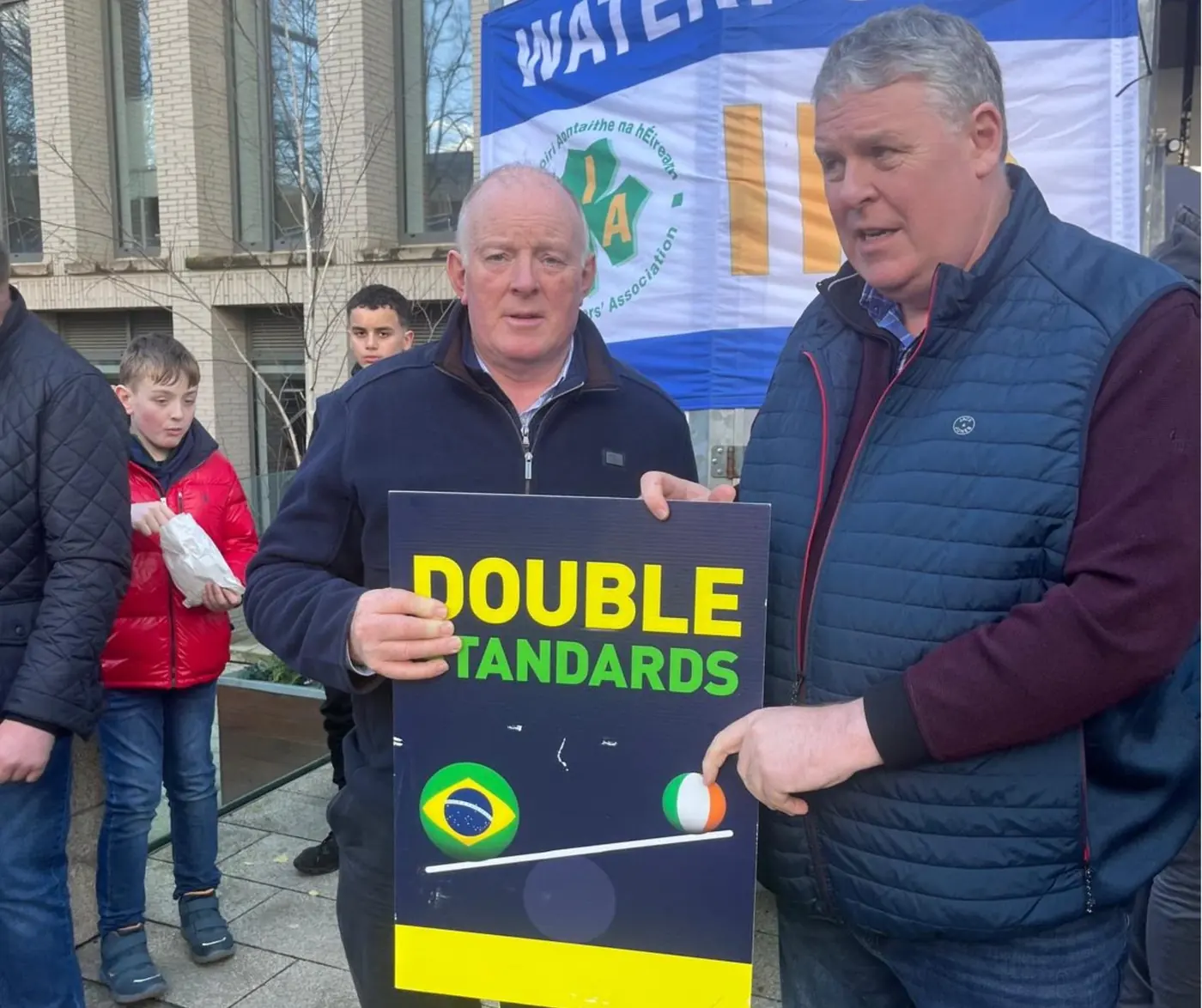 Office of Ciaran Mullooly MEPHolding a “Double Standards” placard at a national protest against the EU–Mercosur trade deal
Ciaran described the Athlone protest against the EU– agreement as a defining moment for the future of rural Ireland, comparing the turnout — which he put at close to 30,000 people — to the Farmers’ Rights Campaign of the 1960s. He said the weekend had changed the nature of the argument, and pledged to follow it with strategic action alongside colleagues in the European Parliament.
The comparison he reached for is a specific one in Irish memory. The Farmers’ Rights Campaign culminated in the 1966 march from Bantry to Dublin led by Rickard Deasy, and in a three-week sit-down outside the Department of Agriculture in Merrion Street. It is remembered as the moment Irish farming organised itself into a political force that governments could no longer treat as a constituency to be managed. Invoking it is a claim about scale and about consequence, not just about numbers on a day.
What made Athlone unusual was its geography and its composition. People travelled from Malin to Mizen Head, in cars, tractors and lorries, to a town chosen because it is within a few hours of almost anywhere in the country. The event was organised by Ciaran with Michael Fitzmaurice TD and supported by the farm organisations, and it drew in people beyond farming — rural businesses, marts, contractors and families whose local economies rest on livestock.
From a field in Athlone to a committee room in Brussels
The strategic action he promised had a clear target. The Mercosur agreement had already cleared the stage at which national governments express their position, which meant the remaining decision points lay with the European Parliament: the consent vote that must happen before the agreement can enter into force, and the question of whether the Parliament would ask the Court of Justice for an opinion on the legality of how the Commission had packaged the deal.
In the weeks that followed, Ciaran wrote to every Irish MEP, invited the Taoiseach and Tánaiste to Strasbourg, delivered a petition of more than 30,000 signatures to the Commission President’s office and worked with colleagues to persuade wavering members from Italy and France. On 21 January the Parliament voted 334 to 324 to refer the agreement to the Court. That margin of ten votes is the practical measure of what a campaign of that kind can be worth.
Mercosur — Brazil, Argentina, Paraguay and Uruguay, with Bolivia acceding — agreed terms with the European Union at the end of 2024 after more than two decades of negotiation. The deal opens a large protected market to European industry and admits South American agricultural produce, including a substantial beef quota, on much improved terms. In the counties Ciaran represents, where the suckler herd is concentrated and farm incomes are thin, that quota is the whole of the argument.
Read moreWestmeath Independent
Source: TheJournal.ie, 21 January 2026. Seat layout is illustrative.
The Commission negotiates trade agreements on behalf of all 27 member states. National governments approve them in the Council, and the European Parliament must give its consent. “Mixed” agreements, which cover areas where member states keep powers, must also be ratified by every national parliament.
For Mercosur, the Commission split the deal into an interim trade agreement and a separate partnership agreement, so the trade part would not need ratification by national parliaments. In January 2026 the Parliament voted 334–324 to ask the Court of Justice whether that approach is lawful.
Related.
 Mullooly Matters
: From the Cavan Farm to Brussels, Sophie Bell on Farming’s Future
The new episode of Ciaran’s weekly podcast features Sophie Bell, a young farmer from Virginia, Co. Cavan, on farming’s future.
 Diliff, CC BY-SA 3.0, Wikimedia Commons
‘UK must ban Brazilian beef next’: Ciaran welcomes the EU–UK food and agriculture agreement
Ciaran welcomed the conclusion of negotiations on a new EU–UK agreement on food, agriculture, animals and plants, due to apply from 1 March 2028, and called for strong food-safety safeguards and no gaps for third-country imports.
 Wikimedia Commons
Ciaran tells ICOS: no change to animal transport rules, and they must take Ireland’s position into account
Ciaran, a full member of the AGRI Committee, met ICOS in the European Parliament for an update on the Commission’s proposed changes to EU animal transport rules. No changes have been agreed by Parliament’s Agriculture or Transport committees.