Retention of the nitrates derogation is essential for Ireland
The first Irish MEP of this term to appeal directly to Parliament colleagues to support Ireland’s case on the nitrates derogation.
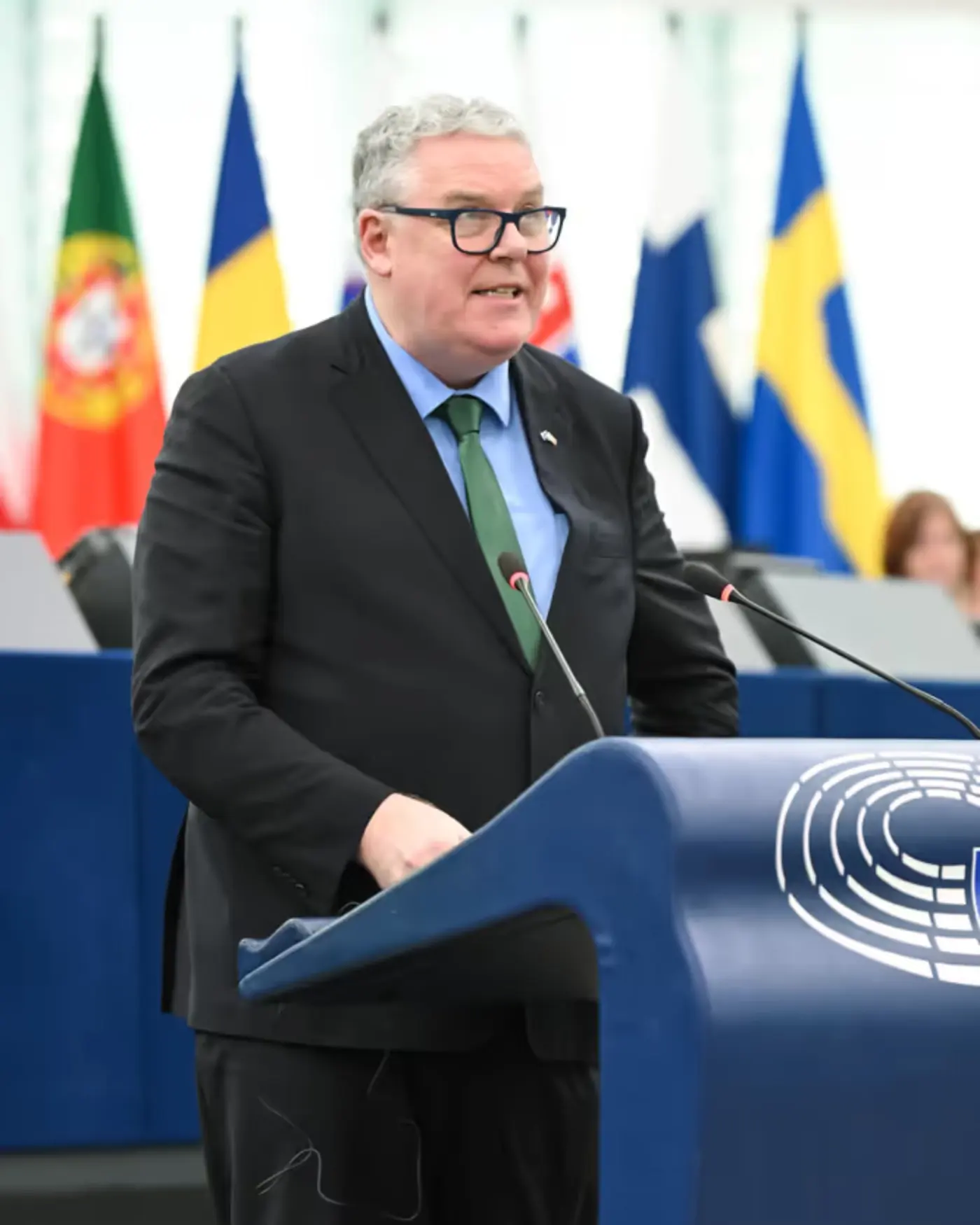 Office of Ciaran Mullooly MEPAddressing plenary, Strasbourg
Ciaran used a speech in the European Parliament to appeal directly to colleagues from other member states to support Ireland’s case for retaining its . He was the first Irish MEP of this parliamentary term to make that appeal on the floor of the chamber, and the argument he made was about the particular character of Irish farming rather than a general request for leniency.
The allows certain Irish farmers to apply up to 220kg of livestock manure nitrogen per hectare each year, where the limit set across the European Union by the Nitrates Directive is 170kg. The justification is Ireland’s climate and its grass-based system: a long, wet growing season means grass takes up nitrogen for far more of the year than in drier or colder parts of Europe, so the same application produces less run-off.
“Ireland has a unique ability to grow lush green grass, which has the least impact on our environment.”
He set out what farmers have already done rather than asking for an exemption on trust. Ireland brought in a subsidised national liming programme to correct soil pH, which improves the efficiency with which grass uses nitrogen; low-emission slurry spreading equipment has been adopted widely and has proved highly effective at reducing losses to air and water; crude protein levels in animal feed have been reduced, cutting the nitrogen excreted in the first place; and farmers have gone through environmental training and worked on farm biodiversity.
The stakes for the region he represents are direct. “Losing this derogation would be devastating for Irish family farms, particularly in the Midlands and North-West,” he told the chamber. A farm that can no longer spread the manure its herd produces must either reduce stock numbers or acquire more land, and land in counties such as Cavan, Monaghan, Longford and Westmeath is both scarce and expensive. For a young farmer who borrowed against a herd, the effect would be felt within a single season.
Why he was asking other MEPs
A decision on the derogation rests with the European Commission, taken on the advice of the Nitrates Committee on which member states are represented, and it depends on evidence about water quality. But the political weather around such decisions is made in the Parliament and in national capitals, and members from other countries who understand why an Irish exception exists are more likely to support it than members who see only a higher number than their own farmers are allowed.
That is the reasoning behind his approach throughout the term: appealing in the chamber, bringing MEPs from other member states to Irish farms so that they can see the grass and the slurry equipment for themselves, and raising the issue with Commissioners-designate during their confirmation process. “I appeal to MEPs to bring the message back that Ireland has a very special case to retain its derogation,” he told the Parliament. A decision was expected before the end of 2025.
Sources: Commission CAP proposal; AGRI Committee; Roscommon People, 30 June 2026; Midwest Radio, 5 May 2026; CSO Farm Structure Survey 2023.
The CAP is the EU’s farm policy and one of its largest budget lines. It pays direct supports to farmers (Pillar 1) and funds rural development, including agri-environment schemes, young farmer supports and LEADER (Pillar 2).
The next CAP will run from 2028 to 2034. The Commission has proposed merging it into single national and regional plans, which would end its ring-fenced budget. Parliament’s Agriculture Committee, where Ciaran is a full voting member, is now amending the proposals before negotiations with national governments.
Related.
 Mullooly Matters
: From the Cavan Farm to Brussels, Sophie Bell on Farming’s Future
The new episode of Ciaran’s weekly podcast features Sophie Bell, a young farmer from Virginia, Co. Cavan, on farming’s future.
 Diliff, CC BY-SA 3.0, Wikimedia Commons
‘UK must ban Brazilian beef next’: Ciaran welcomes the EU–UK food and agriculture agreement
Ciaran welcomed the conclusion of negotiations on a new EU–UK agreement on food, agriculture, animals and plants, due to apply from 1 March 2028, and called for strong food-safety safeguards and no gaps for third-country imports.
 Wikimedia Commons
Ciaran tells ICOS: no change to animal transport rules, and they must take Ireland’s position into account
Ciaran, a full member of the AGRI Committee, met ICOS in the European Parliament for an update on the Commission’s proposed changes to EU animal transport rules. No changes have been agreed by Parliament’s Agriculture or Transport committees.