Irish fishing leaders brief Ciaran and other MEPs in Brussels
The Seafood Ireland alliance of producer organisations met Irish MEPs, including Ciaran, to seek support for quota reform and a change of course on the Common Fisheries Policy.
Leaders of the Irish fishing industry travelled to Brussels to brief Irish MEPs, Ciaran among them, on the state of the sector and to seek support for a fundamental change of direction in European fisheries policy. They came as a new alliance, Seafood Ireland, formed to present a single case rather than five separate ones.
The alliance brings together the Irish Fish Producers Organisation, the Killybegs Fishermen’s Organisation, the Irish South and West Fish Producers Organisation, the Irish South and East Fish Producers Organisation and the Irish Fish Processors and Exporters Association. Between them they represent the catching and processing sides of an industry that is concentrated in coastal communities — in Ciaran’s constituency, in Donegal above all, where Killybegs is the country’s largest fishing port.
The figures they brought were stark. The value of landings by Irish vessels fell by €37 million in 2023, and gross profit in the catching sector dropped by 82%. On the processing side, Brendan Byrne of the processors and exporters association called it the worst year in the history of Irish fish processing, with 151 jobs already lost and the prospect of capacity falling by between 30% and 40% within two years. Aodh O’Donnell of the Irish Fish Producers Organisation warned that without immediate action there were fears of widespread business closures and of operators leaving fishing permanently.
What they are asking for
The central demand concerns quota. Dominic Rihan put it directly: “It’s time our share of EU quotas reflected our 12% share of the waters.” Ireland’s exclusive economic zone accounts for a large share of the Union’s fishing waters, but the quotas Irish vessels receive are far smaller in proportion, because allocations were fixed decades ago on the basis of historical catch patterns under a principle known as and have barely moved since.
Brexit made that worse. Under the Trade and Cooperation Agreement between the European Union and the United Kingdom, quota was transferred from the Union to the UK, and Ireland carried a disproportionate share of that loss relative to other member states. John Lynch spoke of the need to “place the Irish fishing industry back onto a level playing field”, and the alliance asked for government action to mitigate what it regards as a disastrous outcome.
The alliance also raised a representational problem: Ireland has no full member on the European Parliament’s Fisheries Committee, known as PECH — only a substitute seat, held by fellow Midlands–North-West MEP Luke Ming Flanagan — which limits the industry’s ability to influence legislative proposals at the stage where amendments are actually drafted. That makes briefings with Irish MEPs on other committees, including Ciaran, more important rather than less.
How fishing quotas are set
Each December the of fisheries ministers agrees total allowable catches for the year ahead, stock by stock, informed by scientific advice from the International Council for the Exploration of the Sea. Each member state then receives a fixed percentage share of each catch. Ireland also benefits from the , agreed in 1976 to recognise the particular dependence of Irish and northern Scottish coastal communities on fishing, which can increase Ireland’s share of certain stocks when quotas fall below defined levels — though their application has to be argued for each year rather than being automatic.
Read moreRTÉ IFPO The Skipper
Sources: ICES advice as reported by Donegal Live, 13 November 2025.
Under the Common Fisheries Policy, EU ministers set annual catch limits (total allowable catches) for each stock, based on scientific advice from ICES, and share them between member states using fixed keys based largely on historic catches from the 1970s.
The Hague Preferences, agreed in 1976, allow regions heavily dependent on fishing, including Ireland, to receive a larger share when quotas for key stocks are cut sharply. Ciaran has called for them to be invoked to protect Killybegs, Castletownbere and coastal communities.
Related.
 Wikimedia Commons
Future investment and reform essential in the fishing sector
Ciaran said Irish fishermen and coastal communities need greater investment, not further cuts, and that the fisheries budget must at the very minimum be fully restored. He said he has corrected his vote on a Left group amendment on the 2027 budget to reflect that position.
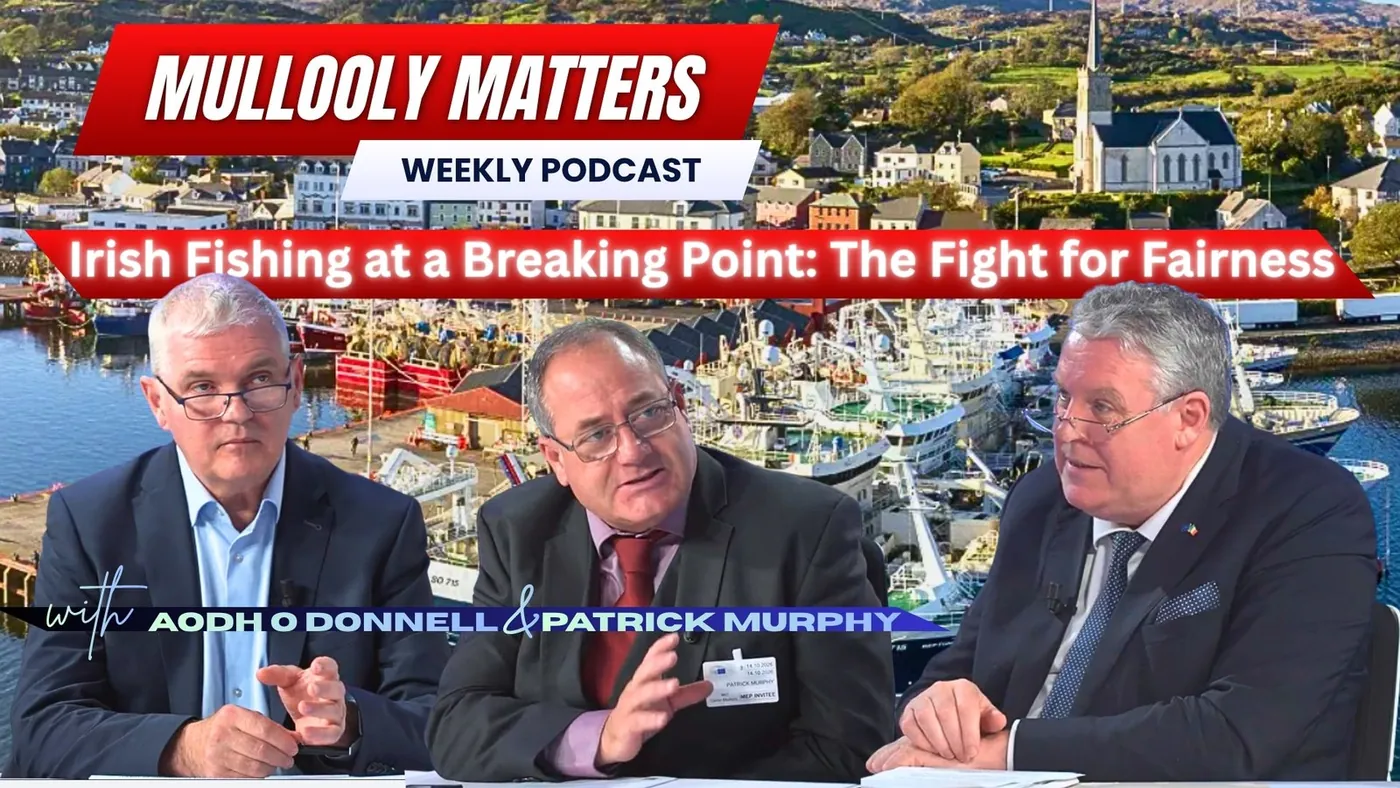 Mullooly Matters
: Irish Fishing at a Breaking Point, The Fight for Fairness
The new episode of Ciaran’s weekly podcast, with Aodh Ó Donnell of the Irish Fish Producers’ Organisation and Patrick Murphy of the Irish South and West Fish Producers’ Organisation, on the state of the Irish fishing industry.
Supporting the King of the Lake International Pike Festival on Lough Ree
Ciaran was thanked by the Lough Ree Angling Hub, alongside Roscommon and Longford county councils, for supporting its biggest ever international pike festival.