Don’t shut social enterprises out of EU funding
Ciaran called on the Government to clarify an EU test that risks excluding not-for-profit companies and social enterprises in the North West from EU and State funding, from engineering firms taking on apprentices to recycling projects.
Ciaran called on the Government to clarify how an EU financial test is being applied to not-for-profit companies and social enterprises in the north west, warning that organisations doing valuable work risk being shut out of both European and State funding by a rule that was never designed with them in mind. The organisations affected range from engineering firms that take on apprentices to community recycling projects.
The test in question comes from European State aid law. Public funding to an undertaking is generally treated as State aid, and the General Block Exemption Regulation, which is what allows most routine grants to be paid without individual notification to Brussels, excludes any body that qualifies as an undertaking in difficulty. The definition is mechanical: it turns on things such as accumulated losses exceeding half of subscribed share capital, or the presence of insolvency proceedings, and it exists to stop public money propping up businesses that are failing.
The difficulty for social enterprises is structural rather than financial. Many are companies limited by guarantee with no share capital at all, so a ratio expressed as a proportion of share capital produces a meaningless or disqualifying result. Many also carry accumulated deficits by design, because they are not permitted to distribute surpluses and they operate on grant income that arrives in arrears. An organisation that is entirely solvent and doing exactly what it was set up to do can therefore fail a test intended to identify firms on the brink of collapse.
Why the north west feels it first
Social enterprise does a disproportionate amount of work in thinly populated counties. Where a commercial operator sees no market — in rural transport, in recycling and reuse, in training, in care, in community facilities — a not-for-profit company staffed locally and funded through a mix of grants and trading income often fills the gap. In Sligo, Leitrim, Donegal, Roscommon and Mayo those organisations are frequently the only provider of the service in question, and several are significant local employers.
The consequence of failing the test is not a smaller grant but no grant. If a body is classified as an undertaking in difficulty, the block exemption is unavailable, and funding bodies administering European or exchequer schemes have little discretion to proceed. That can arise suddenly, when a scheme changes its eligibility screening, and it can put a going concern out of business for reasons unconnected to how it is actually performing.
Ciaran’s request was for clarity rather than exemption in the first instance: a clear statement from Government of how the test is being interpreted for bodies without share capital, so that organisations know where they stand before they commit to an application. The underlying rules are set in Brussels, where the block exemption is periodically revised, and the treatment of social economy organisations has been raised repeatedly at European level. Establishing the Irish position is the necessary first step to arguing the European one.
Read moreOcean FM
Source: Westmeath Examiner, 28 July 2025.
SMEs make up 99% of businesses in the EU. EU rules on the Single Market, trade, State aid and transport shape their costs, and programmes such as LEADER, InvestEU and the agri-food promotion policy can help them grow.
Ciaran is shadow rapporteur on the EU’s agri-food promotion rules, working to widen access for small producers.
Related.
Ciaran: men find it hardest to talk openly about loneliness
Ahead of a European Parliament event on social isolation, loneliness, anxiety and addiction, Ciaran said men, and older men in particular, struggle most to speak openly about loneliness, and that public figures should speak up.
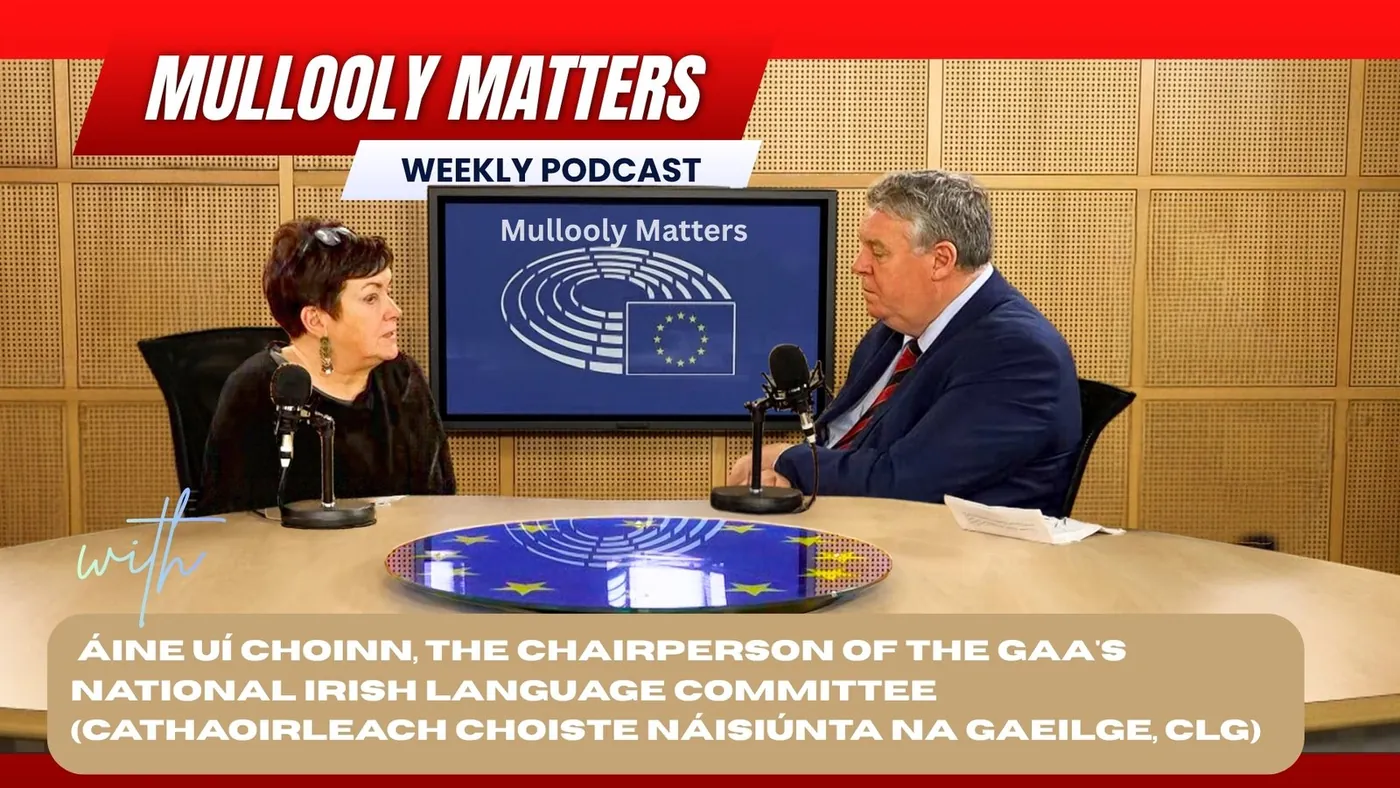 Mullooly Matters
: The Right to Stay – Can Rural Women Build a Future at Home?
Recorded in Brussels during Gender Equality Week, Ciaran talks to Áine Uí Choinn, chairperson of the GAA’s National Irish Language Committee, about what it would take for women and young people to build a life in rural Ireland and stay.
“Absurd costs”: Ciaran presses for packaging rules to be suspended for small businesses
Ciaran backed proposals to suspend EU packaging rules for small and micro businesses and asked the Commission for immediate clarity while negotiations continue. Some regional businesses, he said, face bills of thousands of euro.