Athlone Chamber of Commerce brings Midlands business concerns to Brussels
Ciaran hosted an Athlone Chamber of Commerce delegation, led by President Regina Bushell and CEO Tommy Hogan, for meetings with Commission and Parliament officials on skills shortages, access to EU funding, cross-border trade barriers and recognition of qualifications.
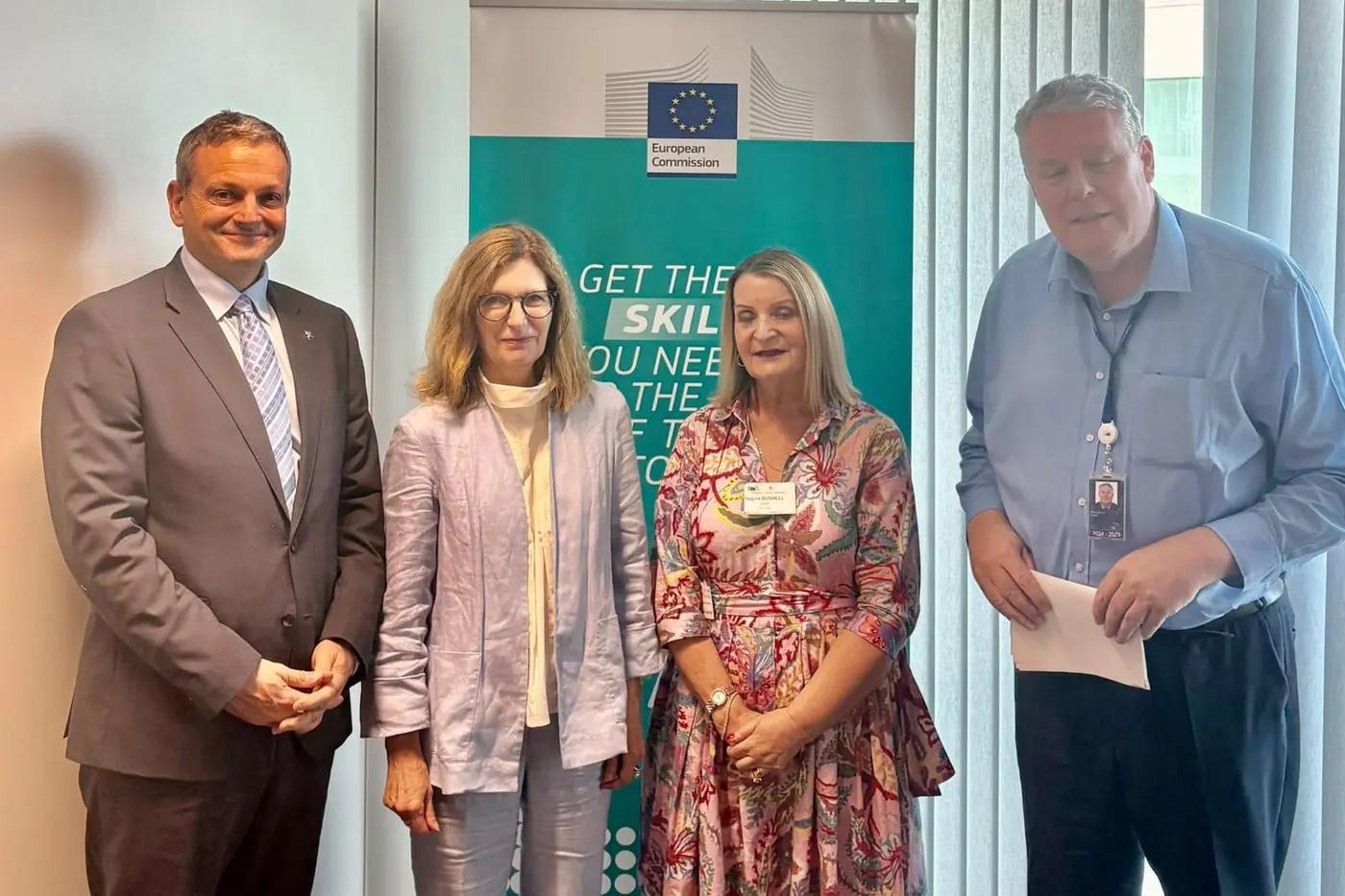 Office of Ciaran Mullooly MEPWith Athlone Chamber of Commerce President Regina Bushell and colleagues, European Commission, Brussels
Ciaran hosted a delegation from Athlone Chamber of Commerce in Brussels, led by its President, Regina Bushell, and Chief Executive, Tommy Hogan, for a programme of meetings with officials from the European Commission and the European Parliament. The agenda was drawn from what Athlone businesses had raised with the Chamber: skills shortages, access to European funding, barriers to cross-border trade and the recognition of professional qualifications.
Each of those is a European competence rather than a purely national one, which is what made the trip worth taking. Recognition of qualifications operates under European directives that determine when a qualification obtained in one member state must be accepted in another, and the practical frustrations — delays, additional requirements, professions where recognition is automatic and professions where it is not — are matters the Commission can act on. Access to funding is governed by the rules of the programmes themselves, and small and medium businesses frequently find the application process more forbidding than the grant is large.
Why Athlone
Athlone sits at the centre of the country on the Shannon, straddling the Westmeath and Roscommon boundary, and is one of the designated regional growth centres in national planning policy. It has a technological university campus, a substantial international employer base in medical devices and software, and a hinterland of smaller firms across the midlands. The Chamber represents that mix, and the concerns its members raised are the ones common to regional business anywhere in Europe: finding skilled staff, competing for talent with capital cities, and navigating rules written for firms with legal departments.
Skills shortages were prominent because they are the most immediate. Employers across the midlands report difficulty filling technical and trade roles, and the problem compounds with housing, since a candidate who cannot find somewhere to live within reach of the job does not take it. The European Union has been developing responses through skills partnerships, apprenticeship mobility and proposals to make it easier for qualified people from outside the Union to work legally within it, though the decisive levers on training and immigration remain national.
Cross-border trade barriers, in an Irish context, often means the frictions that followed the United Kingdom’s departure from the Union: customs declarations, rules of origin, product certification and the treatment of goods moving through Great Britain. For a midlands firm selling into Britain or buying components from it, these are daily operational costs rather than abstractions, and the detail of how they are administered is decided in Brussels and London rather than in Athlone.
Bringing a delegation to Brussels is one of the more concretely useful things an MEP can arrange. It gives business representatives direct contact with the officials who draft the rules, and it gives those officials a specific account of how a regulation lands on a company employing thirty people in the Irish midlands — a perspective that is otherwise supplied mostly by large firms and professional lobbyists. Ciaran, who sits on the Regional Development Committee, has used the same approach with farm groups, community organisations and local authorities.
Read moreRoscommon People
Source: Westmeath Examiner, 28 July 2025.
SMEs make up 99% of businesses in the EU. EU rules on the Single Market, trade, State aid and transport shape their costs, and programmes such as LEADER, InvestEU and the agri-food promotion policy can help them grow.
Ciaran is shadow rapporteur on the EU’s agri-food promotion rules, working to widen access for small producers.
Related.
“Absurd costs”: Ciaran presses for packaging rules to be suspended for small businesses
Ciaran backed proposals to suspend EU packaging rules for small and micro businesses and asked the Commission for immediate clarity while negotiations continue. Some regional businesses, he said, face bills of thousands of euro.
Supporting the King of the Lake International Pike Festival on Lough Ree
Ciaran was thanked by the Lough Ree Angling Hub, alongside Roscommon and Longford county councils, for supporting its biggest ever international pike festival.
Public trust in RTÉ still recovering, says former correspondent turned MEP
Reacting to RTÉ’s 2025 annual report, Ciaran said public confidence in the broadcaster had not fully recovered from its earlier payments controversies.