Mullooly: “Time for cool heads on ALL EU trade deals”
Amid new US tariff threats, Ciaran urged calm and repeated his call for Parliament to seek a Court of Justice opinion on whether the Commission’s route to approving Mercosur complies with the EU Treaties.
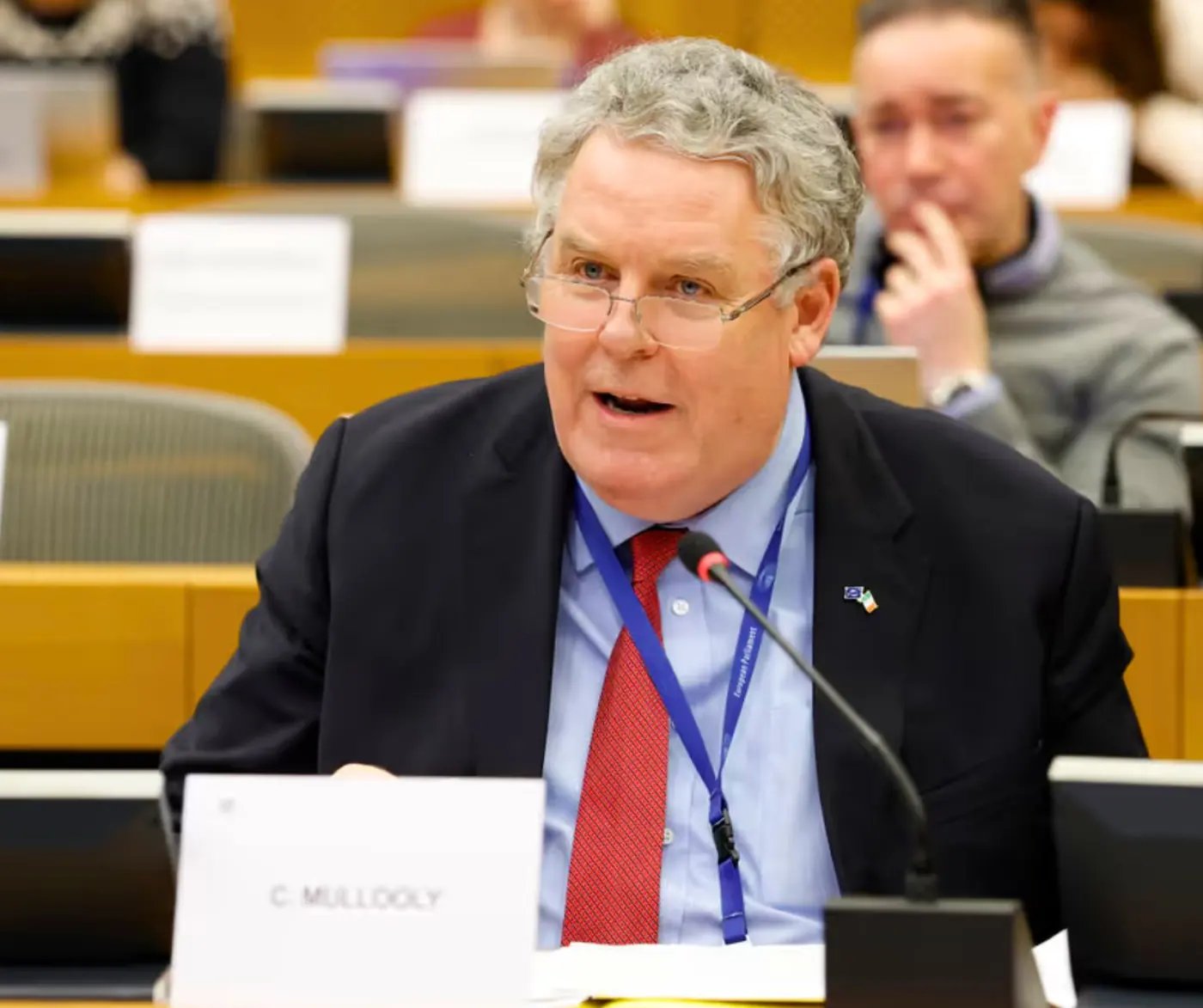
With new tariff threats emerging from the United States, Ciaran urged calm on European trade policy and repeated his call for the European Parliament to seek an opinion from the Court of Justice on whether the Commission’s route to approving the agreement complies with the EU Treaties. His argument was that a period of global trade turbulence is the worst possible moment for Europe to take shortcuts with its own legal procedures.
On Mercosur, his contention is that the agreement should have been treated as a mixed agreement requiring ratification by all member states, in the way the Canadian agreement CETA was handled, rather than split so that the trade elements could be concluded by the European Union alone. More than 145 members of the Parliament had by then questioned the classification. The Commission divided the package rather than presenting it as a single instrument, and the consequence is that national parliaments would have no vote on the part that changes tariffs.
“The fundamental issue is not politics, but legality. Where even a scintilla of doubt exists as to whether the Commission has acted within the Treaties, it is the duty of the Parliament to seek legal clarity from the Court.”
He put the case in terms of Europe’s standing rather than Ireland’s interest. “Europe cannot criticise others for disregarding legal norms while allowing legal shortcuts at home,” he said. “At a time of global trade instability, strict adherence to the Treaties is essential for the credibility of the European Union.” The point is a serious one for an institution whose principal leverage in trade disputes is that it keeps to rules others are accused of breaking.
Cool heads on all deals
The call for cool heads was directed at the wider debate as well. Trade policy is an exclusive competence of the European Union, exercised by the Commission under a mandate from the , with the Parliament holding a consent veto at the end. When a major trading partner raises tariffs, the pressure on Brussels is to respond quickly and visibly, and rebalancing measures — counter-tariffs on a published list of imported goods — are the standard instrument. They are also blunt, and the damage they do at home depends heavily on which products end up on the list.
For Ireland the exposure runs in several directions at once. Pharmaceuticals, medical devices and food are the largest exports to the United States, spirits have already been caught in transatlantic disputes, and Irish farming depends on imported American animal feed for which there is no European substitute in sufficient quantity. A rapid escalation can therefore hurt Irish producers twice over, through the tariffs imposed on them and through the counter-tariffs imposed on their inputs.
Ciaran, who is from County Roscommon and represents Midlands–North-West, sits on the Agriculture Committee and has pursued trade questions through written questions, committee interventions and the Mercosur referral. The Court of Justice request he argued for was ultimately carried by the Parliament in January 2026, by 334 votes to 324.
Source: TheJournal.ie, 21 January 2026. Seat layout is illustrative.
The Commission negotiates trade agreements on behalf of all 27 member states. National governments approve them in the Council, and the European Parliament must give its consent. “Mixed” agreements, which cover areas where member states keep powers, must also be ratified by every national parliament.
For Mercosur, the Commission split the deal into an interim trade agreement and a separate partnership agreement, so the trade part would not need ratification by national parliaments. In January 2026 the Parliament voted 334–324 to ask the Court of Justice whether that approach is lawful.
Related.
 Diliff, CC BY-SA 3.0, Wikimedia Commons
‘UK must ban Brazilian beef next’: Ciaran welcomes the EU–UK food and agriculture agreement
Ciaran welcomed the conclusion of negotiations on a new EU–UK agreement on food, agriculture, animals and plants, due to apply from 1 March 2028, and called for strong food-safety safeguards and no gaps for third-country imports.
 Wikimedia Commons
Ciaran tells ICOS: no change to animal transport rules, and they must take Ireland’s position into account
Ciaran, a full member of the AGRI Committee, met ICOS in the European Parliament for an update on the Commission’s proposed changes to EU animal transport rules. No changes have been agreed by Parliament’s Agriculture or Transport committees.
 Office of Ciaran Mullooly MEP
Commissioner Hansen agrees consumers need clearer food origin information, as Ciaran presses the case
At the Agriculture Committee, Ciaran asked how EU-funded promotion can make European origin clear while keeping Irish origin visible. Commissioner Christophe Hansen said European products “need to be visible” and that the gap Ciaran has raised is real.