Appointed rapporteur on cohesion policy and the just transition
The Regional Development Committee appointed Ciaran to lead its report on how cohesion policy supports regions moving away from carbon-intensive industries.
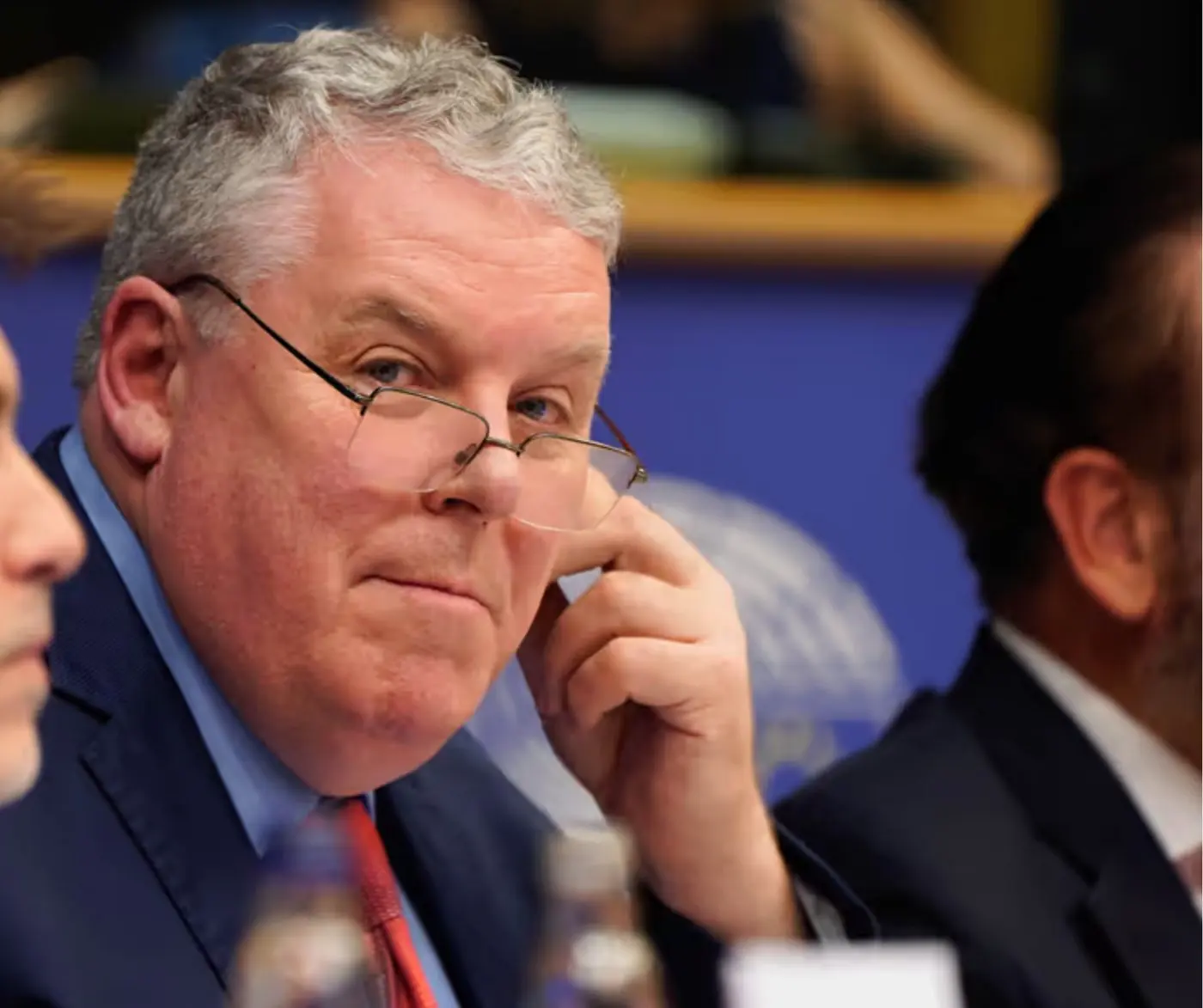 Office of Ciaran Mullooly MEPIn a European Parliament committee room
The European Parliament’s Committee on Regional Development appointed Ciaran as its for a report on the and its effect on European cohesion policy — the committee’s lead author on how Europe supports regions moving away from carbon-intensive industry. It is a significant role for a first-term member, and it places an Irish MEP at the centre of a file that matters directly to his own constituency.
“I am honoured to accept this role, which allows me to bring the experience and needs of our regions directly to the heart of EU policy making.”
A rapporteur is the member who carries a file through the Parliament. The work involves analysing the Commission’s proposals, consulting stakeholders, drafting the report and its recommendations, negotiating amendments with shadow rapporteurs from the other political groups, and then defending the agreed text when it reaches the chamber. The rapporteur does not get their own way — the report has to command a majority — but they set the starting point and shape the argument, which is a substantial form of influence.
Ciaran said the objective was to ensure that all affected regions, Ireland’s midlands among them, receive support adequate to cope with the transition. He also identified the practical problem he has raised repeatedly since taking his seat: “We must work to simplify procedures and reduce administrative burden to ensure that these vital resources reach the communities that need them most, as quickly and efficiently as possible.”
What the Just Transition Fund does
The Just Transition Fund was created as part of European cohesion policy to help regions whose economies depended on carbon-intensive industry through the change away from it: coal in Poland and Germany, lignite in Greece and Czechia, oil shale in Estonia, peat in Ireland. It pays for retraining and reskilling, for enterprise development and business investment, for community projects and for the rehabilitation of industrial and extraction sites. Ireland’s allocation runs to around €169 million up to 2027 and is managed by the Eastern and Midland Regional Assembly.
The Irish territory covered takes in Longford, Westmeath, Laois and Offaly, together with parts of Galway, Kildare, Roscommon and Tipperary — the belt of midland counties where Bord na Móna harvested peat and the ESB burned it. When peat-fired electricity generation ended, the jobs went with it, and in many towns those jobs had been the main employment for two or three generations of the same families.
The report Ciaran leads arrives as the Union begins to consider what comes after the current budget period, which is why it matters beyond its own text. A Parliament report sets out what the institution believes should change: whether the fund continues, at what scale, with what geographic targeting and with what rules for drawing money down. Ciaran has argued that the money must reach the families who lost the wages rather than being spread thinly, and that the administrative burden is itself the reason so little of the Irish allocation has been drawn down. As rapporteur, he is now in a position to write that argument into the Parliament’s formal position.
Read moreAgriland Independent.ie
Ciaran’s report: pre-finance up to 90% for low-risk groups, local grant managers, and a stand-alone JTF 2.0 after 2027.
Sources: Westmeath Independent, 4 July 2025; Offaly Express, 25 February 2026.
The Just Transition Fund supports regions most affected by the move away from fossil fuels, such as the Irish Midlands after the end of peat-fired electricity. Ireland’s allocation of around €169 million runs to 2027, matched by national funding.
In Ireland it is managed by the Eastern and Midland Regional Assembly, with schemes delivered through bodies such as Pobal, Fáilte Ireland and county councils. As Parliament’s rapporteur, Ciaran set out how a better-funded, simpler JTF 2.0 should work after 2027.
Related.
Ciaran hosts a European conference on island communities and the “Right to Stay” in Longford
“Sustainable Development, Depopulation and Connectivity for EU Islands: Challenges, Opportunities and the Right to Stay”, on Friday 27 November at Longford Rugby Club, 10am to 2:30pm. Free, with limited places.
 Office of Ciaran Mullooly MEP
Ciaran pays tribute to local firefighters at European Parliament fire safety event
Ciaran welcomed four local firefighters to the European Parliament for “Safer Homes for Europeans: Integrating Fire Safety into EU Housing Policy”, held on 18 November during European Fire Safety Week.
Ciaran: Government should borrow from the European Investment Bank to deal with shameful housing record as homelessness exceeds 18,000
Speaking in the European Parliament’s Special Committee on the Housing Crisis, where he is Vice-Chair, Ciaran challenged the Government over the latest figures: 18,065 people, including 5,897 children, in emergency accommodation.