Welcoming the new Government’s opposition to Mercosur
Ciaran welcomed the commitment in the new Programme for Government to work with other EU countries to oppose the Mercosur deal, which farmers across Sligo, Leitrim and Donegal had demanded.
On 16 January 2025, Ciaran Mullooly welcomed the commitment in the newly published Programme for Government that the incoming administration would work with other EU countries to oppose the current EU– trade deal. Speaking to Ocean FM, he said farmers across Sligo, Leitrim and Donegal — the counties that had lobbied hardest on the issue — would be behind that stance.
The commitment mattered because of what had happened the previous month. The European Commission had concluded negotiations on the EU–Mercosur agreement in December 2024, after a quarter of a century of talks, and the announcement had been met with immediate and sustained opposition from Irish and French farm organisations. Ciaran had called the conclusion of the deal a betrayal, demanded an emergency meeting of agriculture ministers, and travelled to Brussels to protest with farmers. He had already abstained on the confirmation of the new Commission over the issue in November 2024.
The core Irish objection concerns beef. The agreement provides for a substantial tariff-rate quota for South American beef entering the EU at a reduced tariff, a volume concentrated in the high-value cuts that Irish producers depend on for their margin. Irish farm organisations have argued that the imported product is not produced to equivalent standards on animal welfare, traceability, veterinary medicine use or deforestation, and that the deal therefore trades away the incomes of Irish suckler and beef farmers for gains in other sectors and other member states.
For the north-west the exposure is particularly acute. Sligo, Leitrim and Donegal are drystock counties: the land is heavier and the holdings smaller, dairy conversion is not an option on most of it, and suckler and store cattle production is the mainstay. A sustained fall in beef prices in those counties has no obvious alternative to absorb it.
What followed
The Programme for Government commitment did not settle the argument. Over the following year Ciaran pressed the Government to go further: describing its effort against Mercosur as pathetic in June 2025, inviting the Taoiseach and Tánaiste to Strasbourg to oppose the deal, delivering a 30,000-signature petition to the Commission President’s office, organising and addressing a national rally in Athlone that drew 20,000 people, and ultimately leading the cross-party campaign that produced the January 2026 Parliament vote, carried 334 to 324, referring the agreement to the Court of Justice for an opinion.
Read moreOcean FM
Source: TheJournal.ie, 21 January 2026. Seat layout is illustrative.
The Commission negotiates trade agreements on behalf of all 27 member states. National governments approve them in the Council, and the European Parliament must give its consent. “Mixed” agreements, which cover areas where member states keep powers, must also be ratified by every national parliament.
For Mercosur, the Commission split the deal into an interim trade agreement and a separate partnership agreement, so the trade part would not need ratification by national parliaments. In January 2026 the Parliament voted 334–324 to ask the Court of Justice whether that approach is lawful.
Related.
 Diliff, CC BY-SA 3.0, Wikimedia Commons
‘UK must ban Brazilian beef next’: Ciaran welcomes the EU–UK food and agriculture agreement
Ciaran welcomed the conclusion of negotiations on a new EU–UK agreement on food, agriculture, animals and plants, due to apply from 1 March 2028, and called for strong food-safety safeguards and no gaps for third-country imports.
 Wikimedia Commons
Ciaran tells ICOS: no change to animal transport rules, and they must take Ireland’s position into account
Ciaran, a full member of the AGRI Committee, met ICOS in the European Parliament for an update on the Commission’s proposed changes to EU animal transport rules. No changes have been agreed by Parliament’s Agriculture or Transport committees.
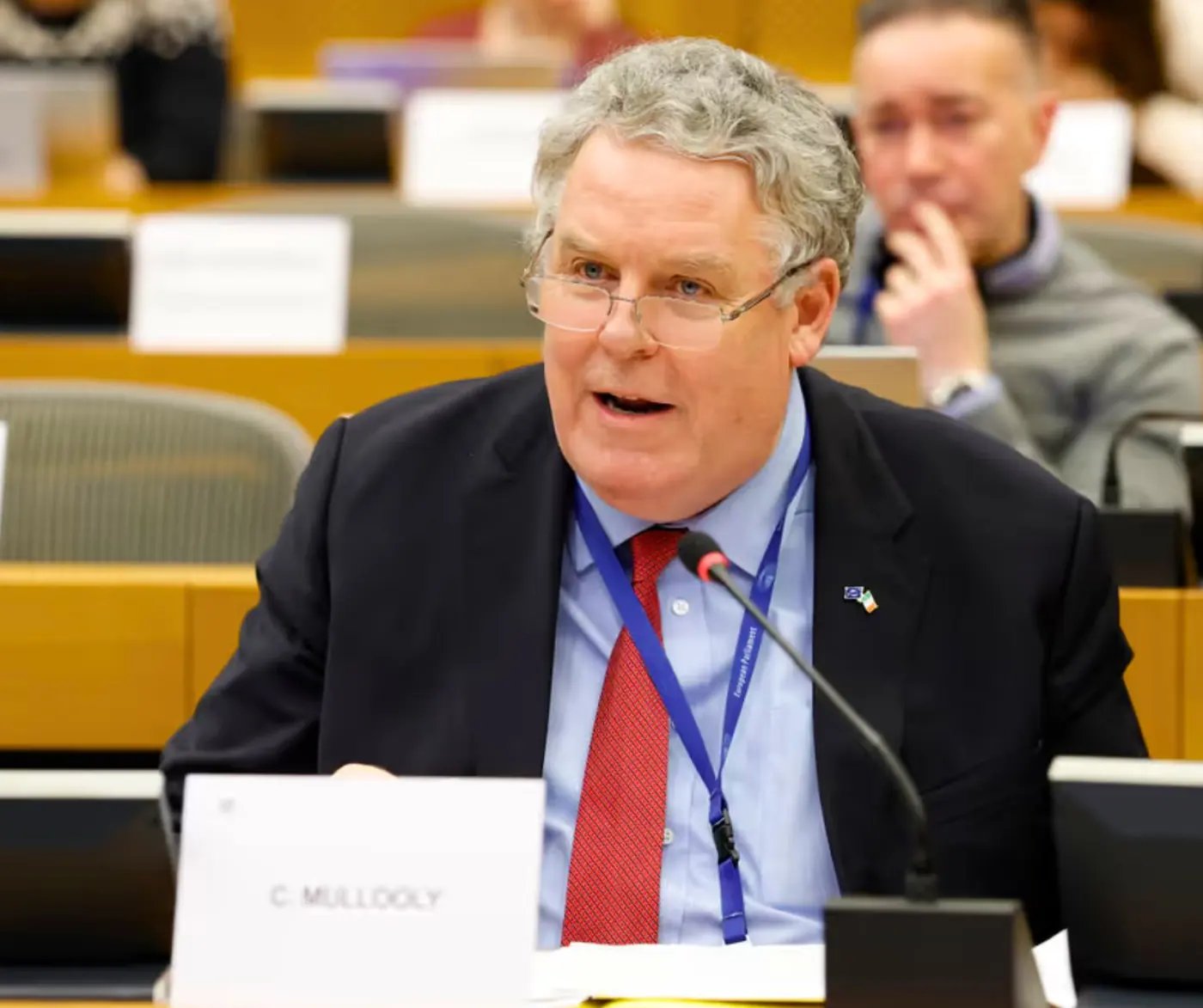 Office of Ciaran Mullooly MEP
Commissioner Hansen agrees consumers need clearer food origin information, as Ciaran presses the case
At the Agriculture Committee, Ciaran asked how EU-funded promotion can make European origin clear while keeping Irish origin visible. Commissioner Christophe Hansen said European products “need to be visible” and that the gap Ciaran has raised is real.