Clarity sought on the threatened 100% US tariff on medicines
Ciaran asked the European Commission to clarify urgently whether a threatened 100% US tariff on branded pharmaceuticals would override the 15% EU–US tariff deal.
Ciaran asked the European Commission to clarify urgently whether a threatened United States tariff of 100% on branded pharmaceutical imports would override the tariff arrangement agreed between the European Union and the United States, under which a ceiling of 15% had been understood to apply. For Ireland the question is not a technical one: pharmaceuticals are the country’s largest export category by value, and the sector employs tens of thousands of people directly.
The uncertainty arose because the two measures come from different legal routes. The 15% figure was the outcome of a negotiated framework between Brussels and Washington covering a broad range of goods. The threatened 100% tariff was announced separately and aimed specifically at branded and patented medicines, as part of an effort to move pharmaceutical manufacturing onto American soil. Whether a sectoral measure of that kind sits inside the agreed ceiling or outside it determines, quite simply, whether the framework means anything.
Ireland’s exposure is unusually concentrated. Much of the world’s supply of several major medicines is manufactured in plants in Cork, Dublin, Waterford, Sligo, Mayo and Westmeath, and the sector is the single largest contributor to Irish goods exports and a very substantial source of corporation tax. A tariff of the size threatened would not close those plants overnight — supply chains and regulatory approvals for medicines take years to move — but it would change every investment decision taken afterwards.
How EU–US trade disputes work
Trade policy is an exclusive competence of the European Union, so member states do not negotiate individually. The Commission negotiates for all twenty-seven under a mandate from the , and where a trading partner raises tariffs the Commission may respond with rebalancing measures — counter-tariffs on a published list of imported goods. Those lists go through a consultation period during which industries can argue for particular products to be removed, which is the point at which a single member state’s exposure can be put on the record.
That consultation stage matters to Ireland in both directions. Irish exports are heavily concentrated in pharmaceuticals, medical devices, food and spirits, all of which have featured in transatlantic disputes. Irish farming, meanwhile, depends on animal feed by-products imported from the United States for which there is no adequate European substitute, so counter-tariffs chosen in Brussels can land on Irish farms as readily as American tariffs land on Irish factories.
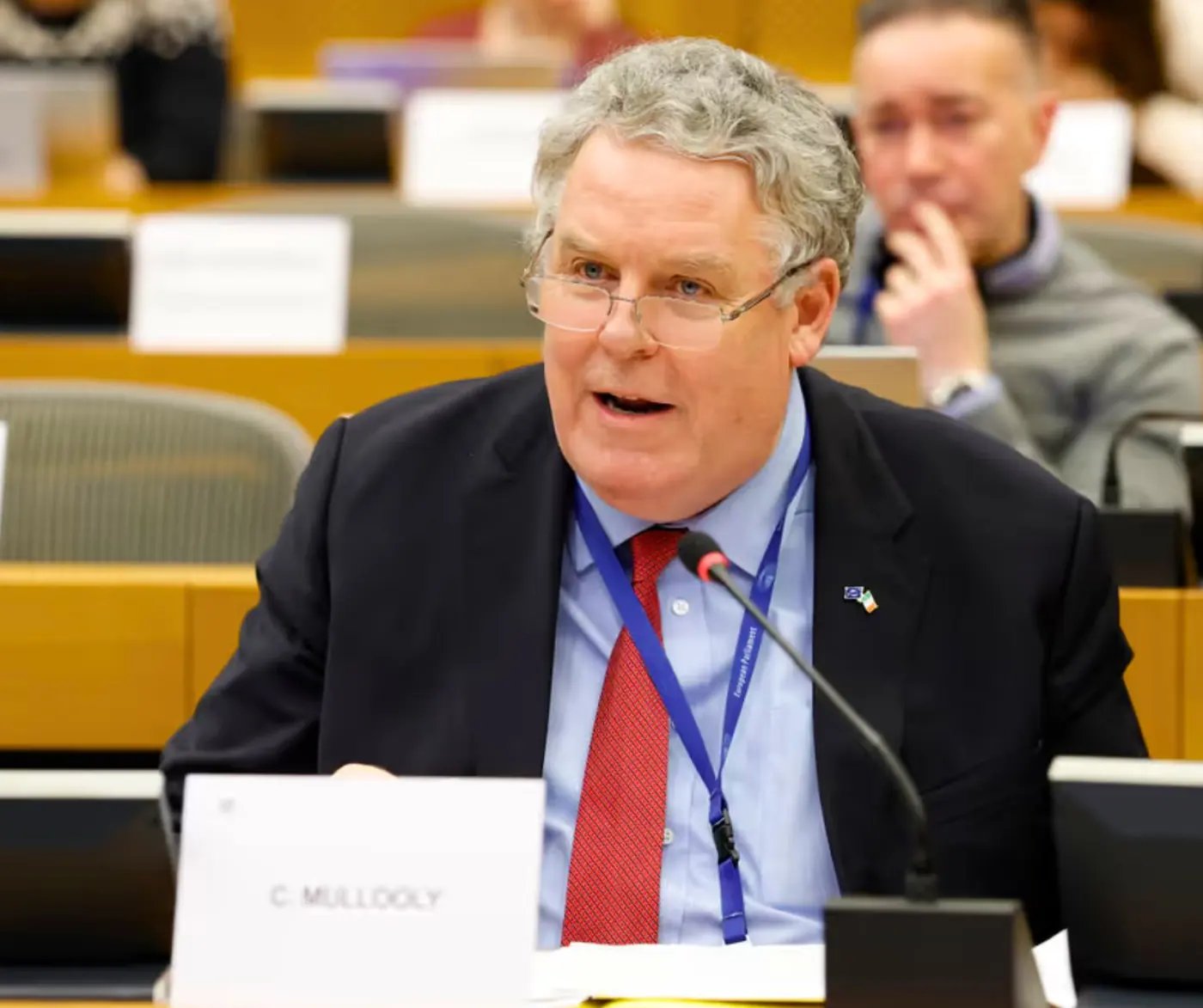
Ciaran, who represents a constituency containing pharmaceutical manufacturing sites in Westmeath, Sligo and Mayo, sought clarity rather than retaliation. His consistent argument through this period has been for what he called cool heads on trade: that Europe should respond in a measured way and should be able to tell its own industries, with certainty, which rate actually applies to them while a dispute is running.
Read moreWestmeath Independent Offaly Independent
Source: TheJournal.ie, 21 January 2026. Seat layout is illustrative.
The Commission negotiates trade agreements on behalf of all 27 member states. National governments approve them in the Council, and the European Parliament must give its consent. “Mixed” agreements, which cover areas where member states keep powers, must also be ratified by every national parliament.
For Mercosur, the Commission split the deal into an interim trade agreement and a separate partnership agreement, so the trade part would not need ratification by national parliaments. In January 2026 the Parliament voted 334–324 to ask the Court of Justice whether that approach is lawful.
Related.
 Diliff, CC BY-SA 3.0, Wikimedia Commons
‘UK must ban Brazilian beef next’: Ciaran welcomes the EU–UK food and agriculture agreement
Ciaran welcomed the conclusion of negotiations on a new EU–UK agreement on food, agriculture, animals and plants, due to apply from 1 March 2028, and called for strong food-safety safeguards and no gaps for third-country imports.
 Wikimedia Commons
Ciaran tells ICOS: no change to animal transport rules, and they must take Ireland’s position into account
Ciaran, a full member of the AGRI Committee, met ICOS in the European Parliament for an update on the Commission’s proposed changes to EU animal transport rules. No changes have been agreed by Parliament’s Agriculture or Transport committees.
 Office of Ciaran Mullooly MEP
Commissioner Hansen agrees consumers need clearer food origin information, as Ciaran presses the case
At the Agriculture Committee, Ciaran asked how EU-funded promotion can make European origin clear while keeping Irish origin visible. Commissioner Christophe Hansen said European products “need to be visible” and that the gap Ciaran has raised is real.