Exporters will need wage subsidies if US tariffs reach 30%
After President Trump threatened 30% tariffs on EU goods, Ciaran called for wage subsidies, marketing grants and tax deferrals for exporting businesses.
After President Trump threatened tariffs of thirty per cent on goods entering the United States from the European Union, Ciaran said Irish exporters would need direct State support to survive it, and named the measures he had in mind: wage subsidies, marketing grants and deferral of tax liabilities. He framed the scale of intervention by reference to the pandemic, arguing that the response would need to be of a comparable order.
“Roscommon businesses who export into the US market, are going to need wage subsidies and key marketing grant supports from IDA Ireland and Enterprise Ireland if Donald Trump’s threatened 30% tariffs actually go ahead.”
He described the potential consequences for Irish businesses and jobs as catastrophic, and pointed to the value at stake. Irish alcohol and beverage exports alone were worth more than €1 billion in 2024, and dairy and alcoholic beverage exports to the United States together exceeded €2 billion. Those are not evenly spread across the country. They are concentrated in food processing plants, creameries and distilleries that are frequently the largest employer in a provincial town, which is why a trade measure decided in Washington lands in places like Roscommon, Longford and Westmeath before it is felt anywhere else.
The logic of a wage subsidy in this situation is about holding a workforce together through a shock. A tariff does not usually destroy a business overnight; it erodes the margin on every unit sold into the affected market, and the immediate management response is to cut costs, which means hours and staff. Once a skilled workforce is dispersed it is expensive and slow to rebuild. A wage subsidy buys time to find alternative markets, which is also why Ciaran paired it with marketing grants aimed at opening those markets, and with tax deferrals to relieve the immediate cash squeeze.
Why the response comes from Brussels and Dublin
Trade policy is an exclusive competence of the European Union. The Commission negotiates with Washington on behalf of all twenty-seven member states, and Ireland cannot conclude a separate arrangement. What national governments retain is the power to support their own firms, and that power is constrained by European state aid rules, which limit what public money may be given to a business and on what terms. During the pandemic the Commission adopted a temporary crisis framework that relaxed those limits substantially, and it has done so again during the energy price crisis. A comparable framework would be needed before an Irish wage subsidy scheme for exporters could lawfully operate.
The threatened thirty per cent rate was not ultimately what emerged; the agreement eventually reached between the European Union and the United States set a baseline tariff of fifteen per cent on European goods, which Ciaran also criticised sharply. His underlying point survives the change in the number. Ireland is a small, extremely open economy with unusually heavy exposure to the American market in exactly the sectors that sustain rural employment, and a decision taken in Washington can remove a margin that an Irish food or drinks business spent a decade building.
Read moreRoscommon People
Source: TheJournal.ie, 21 January 2026. Seat layout is illustrative.
The Commission negotiates trade agreements on behalf of all 27 member states. National governments approve them in the Council, and the European Parliament must give its consent. “Mixed” agreements, which cover areas where member states keep powers, must also be ratified by every national parliament.
For Mercosur, the Commission split the deal into an interim trade agreement and a separate partnership agreement, so the trade part would not need ratification by national parliaments. In January 2026 the Parliament voted 334–324 to ask the Court of Justice whether that approach is lawful.
Related.
 Diliff, CC BY-SA 3.0, Wikimedia Commons
‘UK must ban Brazilian beef next’: Ciaran welcomes the EU–UK food and agriculture agreement
Ciaran welcomed the conclusion of negotiations on a new EU–UK agreement on food, agriculture, animals and plants, due to apply from 1 March 2028, and called for strong food-safety safeguards and no gaps for third-country imports.
 Wikimedia Commons
Ciaran tells ICOS: no change to animal transport rules, and they must take Ireland’s position into account
Ciaran, a full member of the AGRI Committee, met ICOS in the European Parliament for an update on the Commission’s proposed changes to EU animal transport rules. No changes have been agreed by Parliament’s Agriculture or Transport committees.
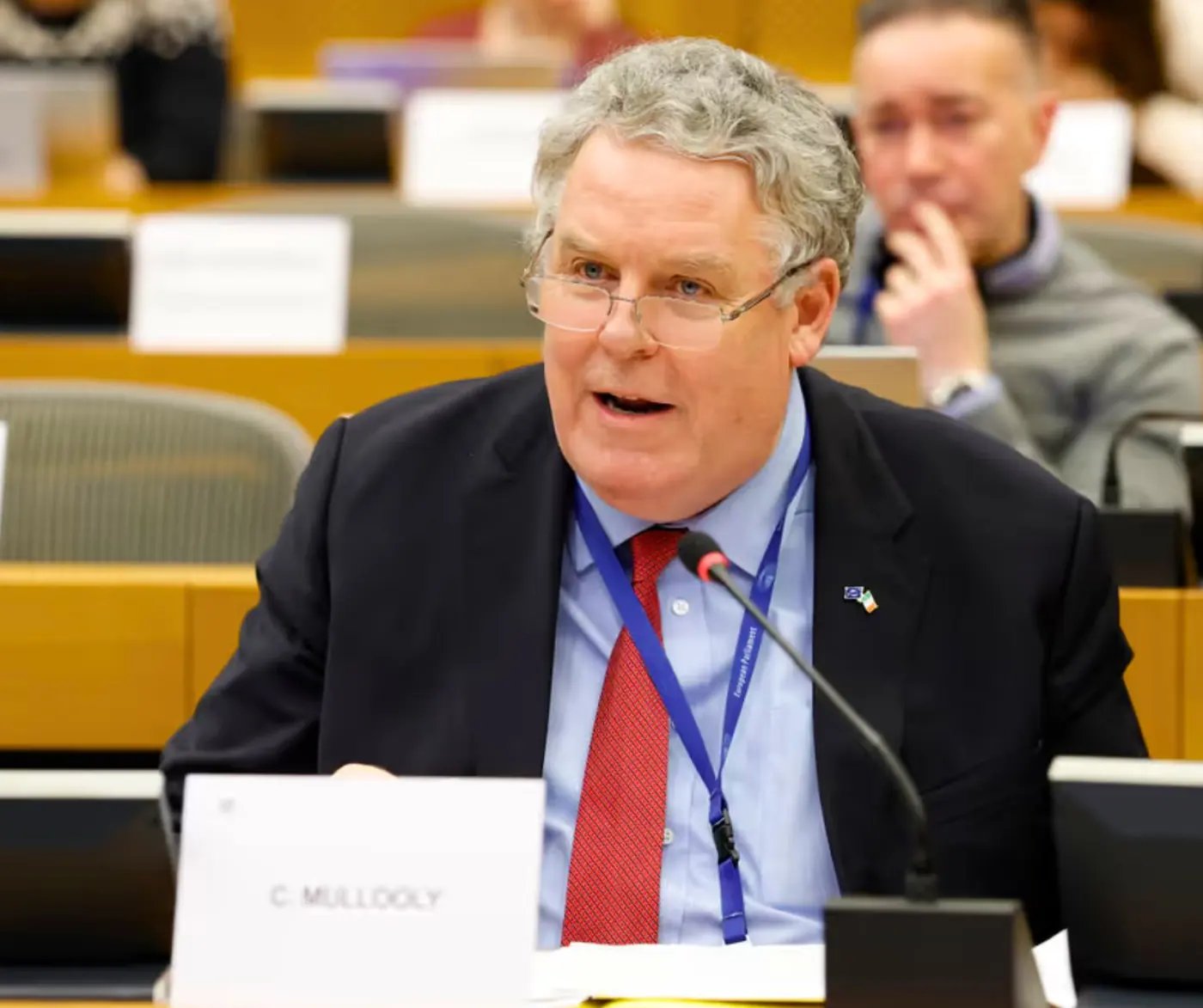 Office of Ciaran Mullooly MEP
Commissioner Hansen agrees consumers need clearer food origin information, as Ciaran presses the case
At the Agriculture Committee, Ciaran asked how EU-funded promotion can make European origin clear while keeping Irish origin visible. Commissioner Christophe Hansen said European products “need to be visible” and that the gap Ciaran has raised is real.